售
Character Story & Explanation
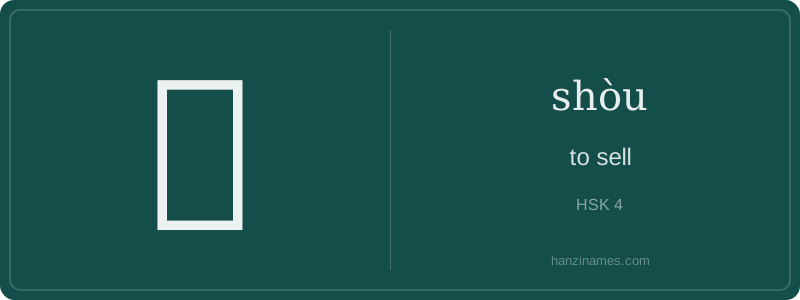
售 appears widely in modern Chinese commerce: on subway ticket machines (自动售票机), shopping mall signage (商品出售处), and government announcements (房屋出售信息). A documented, high-frequency phrase is 售罄 (shòu qìng), meaning 'sold out'—used since at least the early 20th century in Shanghai newspaper ads for theater tickets and books. It’s also in the official term 售后服务 (shòu hòu fú wù, 'after-sales service'), standardized in China’s 1993 Product Quality Law.
The character’s form dates to seal script (c. 3rd century BCE), where it already combined 口 (mouth/speech) and 旁 (phonetic, later simplified). No oracle-bone or bronze inscriptions of 售 exist—its earliest confirmed appearance is in Han dynasty bamboo slips (206 BCE–220 CE), consistently meaning 'to sell'. Today, Chinese shoppers instantly recognize 售 on QR-code receipts, e-commerce apps (e.g., Taobao’s ‘立即购买’ button is sometimes labeled ‘售’ in minimalist UIs), and train station ticket windows.
Hi students! Let’s learn 售 (shòu), a Level 4 HSK character meaning 'to sell' or 'to retail'. It’s not just about handing over goods—it carries the idea of formal, commercial selling, like in stores or official transactions. Notice its radical 口 (kǒu, 'mouth'), which often signals speech-related or communication-based actions—here, it hints at the verbal exchange involved in sales: bargaining, pricing, advertising. This helps you remember that 售 is more active and transactional than general words for 'give' or 'exchange'.
The right side, 旁 (páng), originally meant 'side' or 'beside', but in 售 it serves mainly as a phonetic component—its pronunciation (páng) is *not* close to shòu, showing how sound values shifted over time. Don’t worry—this is common in modern characters! Focus instead on the whole shape: 口 + 旁 = 11 strokes, with a clear top-to-bottom, left-to-right stroke order. Practice writing it slowly while saying 'shòu' aloud each time.
Remember: 售 is almost never used alone in spoken Chinese—it appears in compounds like 出售 (chūshòu, 'to put up for sale') or 售票 (shòu piào, 'to sell tickets'). You’ll see it on price tags, store signs ('本店出售文具'), and official notices. It’s formal and neutral—not slangy or emotional—so avoid using it in casual chats like 'I sold my old phone'; instead, use 卖 (mài), which is more versatile and colloquial. Mastering this distinction is key to sounding natural!
Example Sentences
Common Compounds
Similar Characters — Don't Mix These Up
Your First Step into Chinese Culture: Get a Chinese Name
Every journey into Chinese begins with a name. Use our free Chinese name generator to create a meaningful, personalized Chinese name that fits you perfectly.
Get My Chinese Name →