围
Character Story & Explanation
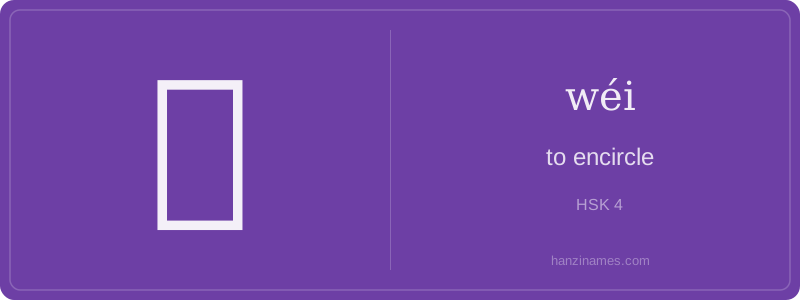
围 is ubiquitous in daily Mandarin: it appears in common verbs like 围观 (wéiguān, 'to gather and watch')—a frequent phenomenon at street incidents—and in set phrases like 围城 (wéichéng, 'besieged city'), popularized by Qian Zhongshu’s 1947 novel critiquing marriage and societal expectations. Historically, it appears in classical military texts like Sun Tzu’s Art of War (c. 5th century BCE), where 围 points to strategic encirclement as a decisive tactic (e.g., 围魏救赵, 'besiege Wei to rescue Zhao').
Graphically, 围 evolved from seal script (c. 3rd century BCE), where the outer 囗 clearly represented an enclosing wall or boundary, and the inner 韋 (wéi, originally meaning 'tanned leather' but here serving phonetically) provided sound. It is not a pictograph of a physical object but a phono-semantic compound—standard for many HSK-4 characters—with documented form stability since the Han dynasty.
The character 围 (wéi) embodies a foundational spatial and relational concept in Chinese thought: enclosure as both protection and constraint. Unlike Western notions that often privilege openness or individual autonomy, 围 reflects a worldview where boundaries define belonging—whether a family courtyard, a military formation, or social norms. Its radical 囗 (wéi), meaning 'enclosure', appears in characters like 国 (guó, 'state') and 园 (yuán, 'garden'), revealing how identity and order are imagined within bounded, purposeful spaces.
This idea resonates across Chinese philosophy and practice—from Confucian rites that ‘encircle’ behavior with ritual propriety (礼, lǐ) to traditional architecture where courtyards (院, yuàn) physically and symbolically gather kinship, hierarchy, and harmony. Encircling isn’t isolation; it’s intentional containment that enables coherence, safety, and shared meaning. The act of surrounding thus becomes generative—not limiting, but nurturing structure.
In modern usage, 围 retains this duality: it describes digital ‘surrounding’ (e.g.,围攻 wéigōng, 'cyber mobbing') and communal care (围炉 wéilú, 'gathering around the brazier'). This semantic elasticity reveals a cultural comfort with paradox—boundaries that unite rather than divide, limits that enable flourishing. To understand 围 is to glimpse how Chinese civilization has long balanced freedom and form, openness and rootedness, through the quiet power of the circle.
Example Sentences
Common Compounds
Similar Characters — Don't Mix These Up
Your First Step into Chinese Culture: Get a Chinese Name
Every journey into Chinese begins with a name. Use our free Chinese name generator to create a meaningful, personalized Chinese name that fits you perfectly.
Get My Chinese Name →