基
Character Story & Explanation
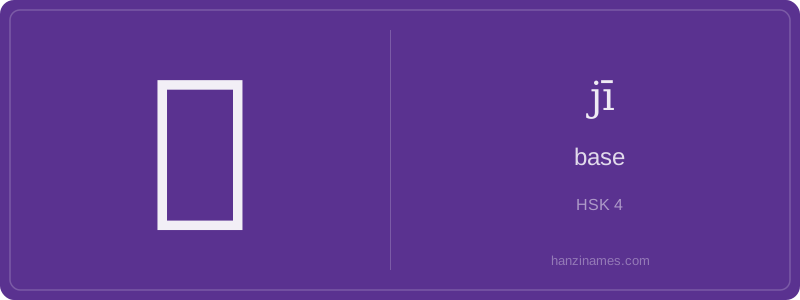
In modern Chinese, 基 appears ubiquitously in education, policy, and science: HSK vocabulary lists label it ‘HSK 4’, reflecting its essential role in intermediate fluency. It anchors common phrases like 基础教育 (jīchǔ jiàoyù, ‘basic education’) and 基建 (jījiàn, ‘infrastructure’ — short for 基础设施建设). The idiom 万丈高楼平地起 (wànzhàng gāolóu píngdì qǐ, ‘a ten-thousand-zhang tower rises from level ground’) implicitly invokes 基 — emphasizing that all greatness requires an unshakeable foundation.
The character’s form is well-documented: it’s a semantic-phonetic compound — not a pictograph — first attested in bronze script as 土 + 其. While 其 originally depicted a dustpan (and later became a pronoun), here it serves phonetically. No oracle bone form survives, but Zhou-era bronzes confirm its early use in inscriptions about ancestral temples and territorial boundaries — places where ‘foundation’ was both literal and sacred.
Our detective begins at the crime scene: the character 基, first unearthed in bronze inscriptions of the Western Zhou dynasty (c. 1046–771 BCE). Its earliest forms combine 土 (earth/soil) with its phonetic component 其 (qí), suggesting a compound meaning rooted in physical grounding — literally 'earth-supporting structure.' Unlike purely pictographic characters, 基 emerged as a semantic-phonetic compound (xíngshēng zì), where the radical signals domain (earth, construction) and the phonetic hints pronunciation.
Zooming in on the radical 土 — a stable, three-stroke emblem of soil and land — we see how it anchors 基’s conceptual weight. In ancient Chinese cosmology and statecraft, earth was the foundational element (wǔxíng), symbolizing stability and sovereignty. Thus, 基 wasn’t just architectural; it carried political resonance: the ‘foundation’ of a dynasty, a ritual altar, or even moral virtue. This layered symbolism persisted through the Han dynasty commentaries, where scholars like Xu Shen explicitly defined 基 as ‘the base upon which things stand.’
By the Tang and Song dynasties, 基 had expanded beyond concrete structures into abstract domains: knowledge (基础知识 jīchǔ zhīshì), ethics (道德基础 dàodé jīchù), and even biology (基因 jīyīn — ‘origin-gene,’ later adopted for ‘gene’ in modern science). Our detective concludes that 基 is less a static glyph than a linguistic keystone — one that evolved not by shape-shifting, but by bearing ever-heavier conceptual loads across millennia.
Example Sentences
Common Compounds
Similar Characters — Don't Mix These Up
Your First Step into Chinese Culture: Get a Chinese Name
Every journey into Chinese begins with a name. Use our free Chinese name generator to create a meaningful, personalized Chinese name that fits you perfectly.
Get My Chinese Name →