堵
Character Story & Explanation
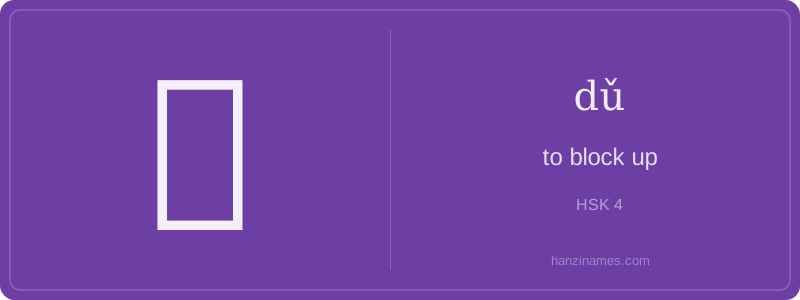
堵 is widely used in modern Chinese for infrastructure and daily life — especially in urban contexts. The term 堵车 (dǔ chē, 'traffic jam') appears constantly in weather reports, news headlines, and navigation apps like Baidu Maps. Beijing and Shanghai officially monitor and report 'traffic congestion index' (拥堵指数), using 堵 as a core metric. A well-documented idiom is 水泄不通 (shuǐ xiè bù tōng, 'not even water can leak through'), where 堵’s semantic field of total blockage is echoed.
The character first appeared in seal script (c. 3rd century BCE), combining 土 (earth/ground) and 者 (zhě, a phonetic component, not 'person'). Its structure isn’t pictographic but phono-semantic: 土 signals meaning (ground-related obstruction), while 者 provides sound. No oracle bone form survives — it emerged later in standardized writing systems.
Hi students! Today we’re learning 堵 (dǔ), a Level 4 HSK character meaning 'to block up' or 'to obstruct'. It’s a very practical word you’ll hear often — whether talking about traffic jams, clogged drains, or even emotional bottlenecks. Notice its radical is 土 (tǔ, 'earth/soil'), which hints at physical obstruction — like earth piling up and blocking a path. This isn’t just abstract: it reflects how Chinese characters often root meaning in tangible, real-world imagery.
The pronunciation dǔ is a third-tone syllable — make sure to start mid-pitch, dip low, then rise slightly (like asking a gentle question). Practice saying it with rising-falling-rising intonation: “dǔ” — not “duh” or “doo”. Since it’s an action verb, it usually appears before or after another verb or noun: e.g., 堵车 (dǔ chē, 'traffic jam') or 把路堵住了 (bǎ lù dǔ zhù le, 'blocked the road').
Don’t confuse 堵 with passive states like ‘blocked’ — it emphasizes the *act* of blocking. It can also be used figuratively: 堵心 (dǔ xīn) means 'feeling emotionally choked or upset', showing how physical metaphors extend into emotion in Chinese. As you learn more verbs like this, you’ll see how deeply interconnected body, environment, and feeling are in the language.
Example Sentences
Common Compounds
Similar Characters — Don't Mix These Up
Your First Step into Chinese Culture: Get a Chinese Name
Every journey into Chinese begins with a name. Use our free Chinese name generator to create a meaningful, personalized Chinese name that fits you perfectly.
Get My Chinese Name →