填
Character Story & Explanation
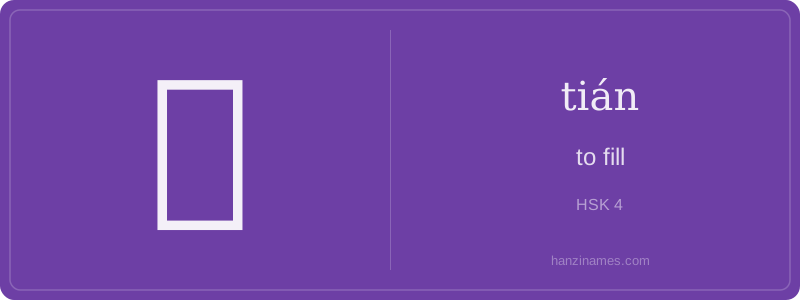
填 is ubiquitous in daily Chinese life: students fill exam answer sheets (填答题卡), citizens fill tax declarations (填纳税申报表), and engineers fill geological survey reports (填地质报告). A key idiom is 填鸭式教育 (tiān yā shì jiàoyù)—'cramming education'—critiquing rote learning by comparing it to force-feeding ducks, a documented farming practice since the Ming Dynasty. The term appears in 19th-century agricultural manuals describing livestock fattening techniques.
The character’s form dates to the Qin-era small seal script (c. 220 BCE): it combines 土 (earth, radical) with 眞 (zhēn, later simplified to 真), originally meaning 'truth' or 'authenticity'—suggesting 'to fill truly', i.e., thoroughly and correctly. Archaeological inscriptions confirm this structure was standardized under imperial unification, emphasizing precision in land management and census records.
The character 填 (tián) embodies a foundational Chinese worldview: harmony through intentional completion. Unlike passive 'filling' in English, 填 implies purposeful, often labor-intensive action—like tamping earth to fortify a wall or packing grain into a granary. This reflects the Confucian and agricultural ethos where order arises from diligent human effort applied to natural materials. The radical 土 (earth) anchors the concept in tangible, life-sustaining substance—soil as both literal ground and metaphorical foundation of society.
Historically, 填 appears in classical texts describing statecraft: filling administrative posts (填补官职), repairing dikes (填塞河渠), or even poetic 'filling' of emotional voids (填愁). Its usage reveals a culture that sees emptiness not as abstract absence but as functional deficiency requiring ethical and practical resolution. To 填 is to restore balance—not by erasing space, but by honoring its role and assigning it proper content.
In modern China, 填 retains this moral weight. Filling out forms (填表) isn’t bureaucratic drudgery—it’s civic participation; filling a job vacancy (填补空缺) carries social responsibility. Even in digital life, ‘filling’ a profile (填资料) echoes ancient rites of inscription: making oneself legible and accountable within a collective structure. Thus, 填 subtly encodes a worldview where meaning emerges not in the void, but in the mindful, earth-rooted act of completion.
Example Sentences
Common Compounds
Similar Characters — Don't Mix These Up
Your First Step into Chinese Culture: Get a Chinese Name
Every journey into Chinese begins with a name. Use our free Chinese name generator to create a meaningful, personalized Chinese name that fits you perfectly.
Get My Chinese Name →