压
Character Story & Explanation
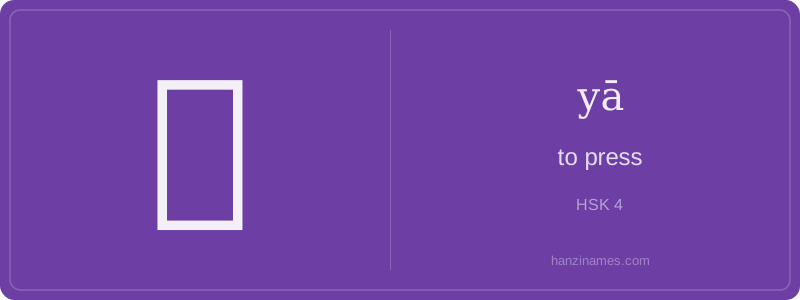
压 is ubiquitous in daily Mandarin: it appears in HSK 4 vocabulary like 压力 (yālì, 'stress/pressure'), 压缩 (yāsuō, 'compress'), and 压低 (yādī, 'to lower [a voice, price, or volume]'). Historically, it was used in Tang dynasty medical texts to describe applying pressure to stop bleeding, and in Qing-era agricultural manuals for soil compaction before planting. A well-documented idiom is 大材小用,如牛负重压 (Dà cái xiǎo yòng, rú niú fù zhòng yā)—'great talent wasted on small tasks, like an ox bearing excessive weight'—highlighting societal expectations as literal load.
The character’s form is not pictographic but phono-semantic: 厂 (radical, meaning 'cliff' or 'shelter') provides spatial context (suggesting something overhead or covering), while 亚 (yà, originally meaning 'second/rank below') serves as the phonetic component. Though 亚 evolved graphically, its early bronze script form resembled a person kneeling under weight—making 压 a conceptual compound: 'force applied from above within a bounded space.'
The character 压 (yā) embodies a fundamental physical and philosophical tension in Chinese thought: the interplay between force and restraint, pressure and resilience. Unlike Western notions that often frame pressure as purely negative, classical Chinese cosmology sees controlled compression—like soil compacting seeds or stone sealing fermentation—as essential for growth, transformation, and preservation. This reflects the Daoist and agricultural worldview where yielding (as in ‘pressing down’) enables emergence (as in ‘sprouting up’).
Historically, 压 appears in early texts not just as mechanical force but as social and moral weight—‘pressing down’ expectations, duties, or authority. In Confucian contexts, it evokes the quiet gravity of responsibility (e.g., 压力 as ‘pressure’ carries connotations of legitimate obligation, not mere stress). The character thus reveals how Chinese language encodes ethics into physics: to press is not to dominate, but to hold space for order and maturity.
This duality permeates modern usage: from pressing tofu (a culinary act requiring precise weight to extract water and firm texture) to ‘pressing’ a button (a digital action with instantaneous effect), 压 bridges ancient material wisdom and contemporary life. Its radical 厂 (cliff/shelter) suggests containment and structure—implying that true pressure operates within boundaries, not chaos. To understand 压 is to grasp how Chinese culture values measured force, disciplined containment, and the generative power of thoughtful constraint.
Example Sentences
Common Compounds
Similar Characters — Don't Mix These Up
Your First Step into Chinese Culture: Get a Chinese Name
Every journey into Chinese begins with a name. Use our free Chinese name generator to create a meaningful, personalized Chinese name that fits you perfectly.
Get My Chinese Name →