失
Character Story & Explanation
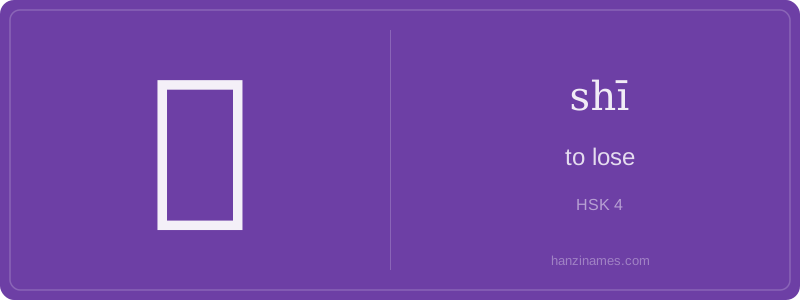
In daily life, 失 appears ubiquitously in high-frequency compounds: 失业 (shīyè, 'unemployment'), 失败 (shībài, 'failure'), and 失眠 (shīmián, 'insomnia'). It’s central to formal and bureaucratic language—e.g., 失物招领 (shīwù zhāolǐng, 'lost-and-found') signs in subways across Beijing and Shanghai. Historically, Confucian texts use 失 to denote ethical dereliction: the *Analects* (12.10) warns against 失言 (shīyán, 'injurious speech')—words that ‘lose’ propriety and harm harmony.
The character’s earliest attested form appears in Warring States bamboo slips (4th c. BCE) as a variant of 失 with slight stroke variations. While no oracle bone form is confirmed, its seal script (221–206 BCE) shows consistent structure: + 丿 + 大. The radical 大 likely serves phonetic reinforcement (early pronunciations of 大 and 失 shared consonantal roots), not semantic 'bigness'—a documented case of phonosemantic compounding in early Chinese writing.
As a linguistic detective, I begin with the oracle bone and bronze inscriptions—yet 失 leaves no clear pictorial trace in earliest forms. Unlike characters such as 日 (sun) or 木 (tree), it lacks an unambiguous object to depict. Scholars agree its form evolved phonetically and semantically from earlier graphs related to 'hand' and 'loss', possibly influenced by the radical 大 (dà, 'big') not for size, but as a phonetic component or structural anchor. Its five-stroke simplicity belies deep functional weight: it anchors verbs of absence, error, and failure.
The character’s structure—top: (a bent line suggesting deviation), middle: 丿 (a falling stroke implying departure), bottom: 大 (radical)—hints at loss as an act of falling away from centrality or control. In ancient texts like the *Zuo Zhuan*, 失 appears in contexts of moral or strategic failure: 'to lose virtue' (失德) or 'to lose advantage' (失机). This semantic gravity persists: modern usage still carries connotation of culpable absence—not mere misplacement, but consequential omission.
Though often glossed as 'to lose', 失 rarely stands alone in speech; it functions almost exclusively in compound verbs or set phrases. You won’t hear someone say *‘Wǒ shī le’* (I lost) without specifying *what*: time, face, opportunity, or temper. Its grammatical role is inherently relational—it demands an object or context. This syntactic dependency mirrors its historical evolution: a character forged not in isolation, but through repeated pairing with nouns denoting things that can be forfeited, misplaced, or abandoned.
Example Sentences
Common Compounds
Similar Characters — Don't Mix These Up
Your First Step into Chinese Culture: Get a Chinese Name
Every journey into Chinese begins with a name. Use our free Chinese name generator to create a meaningful, personalized Chinese name that fits you perfectly.
Get My Chinese Name →