先
Character Story & Explanation
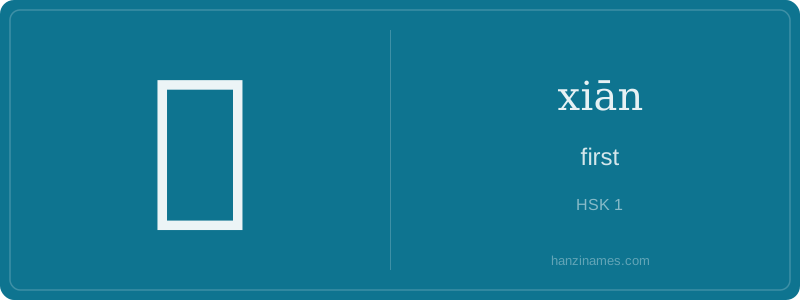
In modern Chinese, 先 is indispensable for politeness and sequencing: ‘先请坐’ (Please sit down first) softens commands; ‘我先走了’ (I’ll leave first) signals graceful exit. It appears in foundational idioms like ‘先发制人’ (xiān fā zhì rén, 'strike first to gain advantage')—documented since the Warring States Strategies—and ‘争先恐后’ (zhēng xiān kǒng hòu, 'vie for first, fear being last'), reflecting Confucian-tinged social urgency. It's also grammatically vital: the particle 先 often precedes verbs to indicate provisional or preparatory action.
The character’s seal-script form (c. 4th c. BCE) clearly shows two upper strokes (indicating ‘above’ or ‘prior’) over 儿 (a kneeling figure), confirming its original meaning as ‘the one before others’. No disputed origin—this structure is consistent across excavated Warring States bamboo texts and Han steles.
As an archaeologist brushing dust from a Han dynasty bamboo slip, I find 先 etched with crisp, confident strokes—no oracle-bone ambiguity here. Its form is stable by the 3rd century BCE: two horizontal lines above 儿 (a stylized human figure), signaling precedence over action or person. This isn’t mythic speculation—it’s philological consensus confirmed by excavated texts like the Mawangdui manuscripts, where 先 consistently modifies verbs to indicate temporal priority.
The character’s six-stroke structure reveals deliberate economy: top two strokes (一 and 丿) represent ‘above’ or ‘before’, while 儿 (child/figure) grounds it in human agency. Unlike pictographs of sun or water, 先 is a semantic compound—not depicting time itself, but *position relative to time*. Early dictionaries like the Shuōwén Jiězì (121 CE) classify it under 儿, confirming its association with human sequence: who acts first, who speaks first, who yields first.
In ritual inscriptions on bronze vessels from the Warring States period, 先 appears in phrases like ‘先王’ (xiān wáng, 'former kings'), establishing ancestral veneration through temporal hierarchy. Its use was never abstract philosophy—it was administrative precision: tax records noted ‘先纳者免役’ (those who paid first were exempted from corvée labor). This practical, ordinal function persists today: 先 isn’t just ‘early’—it’s *strategic priority*, embedded in grammar, etiquette, and law.
Example Sentences
Common Compounds
Similar Characters — Don't Mix These Up
Your First Step into Chinese Culture: Get a Chinese Name
Every journey into Chinese begins with a name. Use our free Chinese name generator to create a meaningful, personalized Chinese name that fits you perfectly.
Get My Chinese Name →