寄
Character Story & Explanation
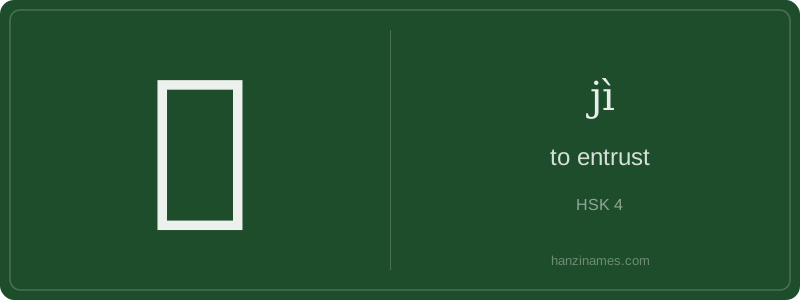
In daily life, 寄 is ubiquitous in logistics and social responsibility: over 120 billion parcels were sent in China in 2023 (State Post Bureau data), with phrases like ‘请寄到’ (qǐng jì dào, 'please send to...') appearing on forms, e-commerce apps, and neighborhood express lockers. Common idioms include 寄人篱下 (jì rén lí xià, 'to live under another’s roof'), historically describing scholars dependent on patrons during imperial exams.
The character’s earliest attested form appears in bronze inscriptions from the Western Zhou (c. 1046–771 BCE), where it combines 宀 (roof/shelter) and 奇 (originally meaning ‘unusual’ or ‘outstanding’). Scholars agree it evolved to signify ‘placing something notable under protection’—not a pictograph, but a semantic-phonetic compound reflecting early bureaucratic record-keeping and gift-giving protocols.
Imagine a young woman in Chengdu carefully packing a box of Sichuan peppercorns, hand-knitted scarves, and a letter for her grandmother in Harbin. She walks to the post office, fills out a parcel form, and hands it to the clerk—this act of transferring care across distance is precisely what 寄 (jì) embodies: entrusting something precious to another person or system, with intention and responsibility.
The character’s roof radical 宀 (mián) signals shelter or domestic space—hinting that ‘entrusting’ begins at home, where one decides what to send and to whom. Beneath it, the phonetic component 奇 (qí) provides pronunciation clues and subtly reinforces the idea of something noteworthy or special being conveyed—not just any object, but one carrying emotional weight or practical need.
In modern China, 寄 extends far beyond mailboxes: students 寄宿 (jìsù) — ‘board’ — entrusting their daily lives to school dormitories; parents 寄养 (jìyǎng) children with relatives during work migrations; even cloud services are described as 数据寄存 (shùjù jìcún), ‘data storage’. Each usage reflects a culturally embedded trust in systems and people to uphold care across separation.
Example Sentences
Common Compounds
Similar Characters — Don't Mix These Up
Your First Step into Chinese Culture: Get a Chinese Name
Every journey into Chinese begins with a name. Use our free Chinese name generator to create a meaningful, personalized Chinese name that fits you perfectly.
Get My Chinese Name →