富
Character Story & Explanation
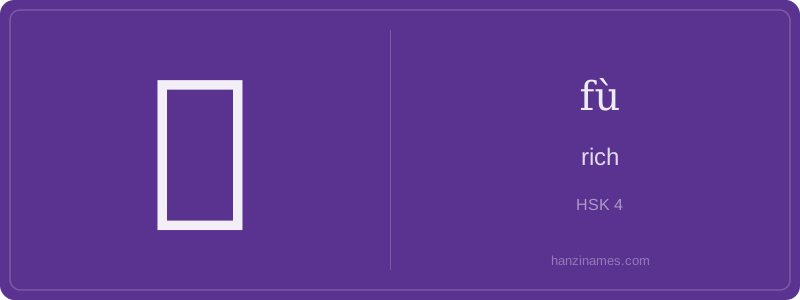
In daily life, 富 is ubiquitous in official discourse and commerce: ‘致富’ (zhì fù, ‘to get rich’) appears in rural development slogans; ‘富有’ (fùyǒu, ‘wealthy/abundant’) describes both financial status and intangible assets like ‘富有创意’ (fùyǒu chuàngyì, ‘full of creativity’). The phrase ‘先富带动后富’ (xiān fù dài dòng hòu fù, ‘the early rich lead the later rich’) reflects China’s staged reform policy, widely cited in state media since the 1980s.
The character’s seal script form (c. 1000 BCE) clearly shows 宀 (roof/household) above 畐—a phonetic-semantic compound where 畐 suggests fullness (originally depicting a wine vessel brimming with foam). Archaeological evidence confirms its use in Western Zhou bronze inscriptions to denote ‘well-provisioned families’, making its ‘abundance under one roof’ origin well-documented—not speculative.
Imagine walking through Shanghai’s Bund at dusk—the skyline glitters with neon reflections on the Huangpu River, luxury boutiques glow beside century-old colonial buildings, and a young entrepreneur chats on her phone about securing funding for her eco-tech startup. This vibrant energy embodies 富 (fù): not just personal wealth, but societal prosperity, resource abundance, and cultivated success. In modern China, 富 carries layered meaning—economic strength, cultural richness, and even moral fulfillment when paired with virtue (e.g., 富而有德).
The character appears everywhere: on bank logos, government slogans like ‘共同富裕’ (gòngtóng fùyù, ‘common prosperity’), and classroom posters teaching socialist core values. It’s never just about money—it’s tied to stability, education, and national rejuvenation. Even in rural villages receiving poverty-alleviation grants, locals use 富 to describe restored farmland yields or newly built village clinics—not just cash, but renewed capacity and dignity.
Historically, 富 appeared in bronze inscriptions over 2,800 years ago, denoting households with ample grain stores and livestock. Its structure—宀 (roof) over 畐 (a vessel overflowing with wine/grain)—visually encodes ‘abundance under shelter’. Today, Chinese learners encounter it early in HSK 4 because it anchors key socioeconomic vocabulary, from business reports to policy debates—and mastering it unlocks nuanced understanding of China’s development narrative.
Example Sentences
Common Compounds
Similar Characters — Don't Mix These Up
Your First Step into Chinese Culture: Get a Chinese Name
Every journey into Chinese begins with a name. Use our free Chinese name generator to create a meaningful, personalized Chinese name that fits you perfectly.
Get My Chinese Name →