尊
Character Story & Explanation
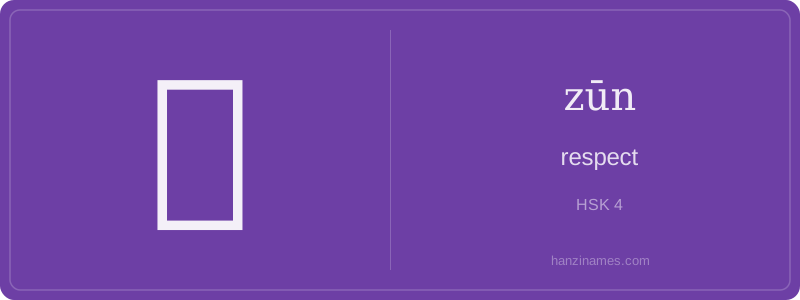
尊 is central to modern Chinese social language, especially in formal address and moral education. It appears in the national curriculum’s ‘Eight Virtues’ (孝悌忠信礼义廉耻), where 尊师重道 (zūn shī zhòng dào, 'respect teachers and value the Way') remains a mandated phrase in primary schools. Historically, it appears in the Confucian classic *Xunzi*, mandating that rulers ‘尊贤’ (zūn xián, 'honor the worthy'). The character also features in legal documents—e.g., China’s 2021 Elderly Rights Protection Law uses 尊老爱幼 (zūn lǎo ài yòu) as a statutory principle.
The character’s form evolved from bronze script: 酉 (wine vessel) + 寸 (hand measuring ritual propriety). This reflects its origin in Shang-Zhou ancestral worship, where offering wine (酉) with measured, reverent gesture (寸) constituted ‘honoring’. No oracle bone form survives, but Western Zhou bronzes (c. 10th–8th c. BCE) show this structure clearly.
As an archaeologist sifting through bamboo slips from the Warring States period, I found 尊 etched in ink on a ritual wine vessel inscription—its form already mature, its meaning anchored in reverence. The top component 酉 (yǒu), originally a pictograph of a wine jar, signals ceremonial use; the bottom 寸 (cùn) — a hand gesture measuring respect — confirms its semantic core: honoring those elevated by age, status, or virtue. This wasn’t abstract philosophy—it was codified social practice.
Excavations at Mawangdui revealed texts where 尊 appears alongside ‘elder’ and ‘teacher’, always paired with verbs like ‘to serve’ or ‘to follow’. Unlike generic honorifics, 尊 carries weight: it implies active deference, not passive acknowledgment. Its twelve strokes map a cultural grammar—each stroke a silent vow to uphold hierarchy through action, not just speech. No oracle bone precursors survive, but bronze inscriptions from c. 1000 BCE show consistent usage in ancestral rites.
Later Han dynasty steles confirm 尊’s lexical expansion: it began modifying nouns directly—尊师 (zūn shī, 'revere teachers'), 尊老 (zūn lǎo, 'honor elders')—transforming from verb to relational marker. Crucially, it never meant ‘senior’ as a neutral descriptor (like 年长者 niánzhǎng zhě); it *demanded* behavioral response. To write 尊 was to invoke duty. That imperative echoes today—in classroom pledges, family contracts, even AI ethics guidelines citing 尊重 (zūnzhòng) as foundational.
Example Sentences
Common Compounds
Similar Characters — Don't Mix These Up
Your First Step into Chinese Culture: Get a Chinese Name
Every journey into Chinese begins with a name. Use our free Chinese name generator to create a meaningful, personalized Chinese name that fits you perfectly.
Get My Chinese Name →