巾
Character Story & Explanation
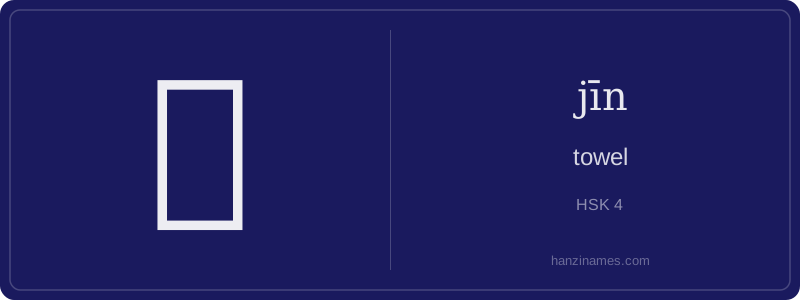
Historically, 巾 appears in early seal script (c. 3rd century BCE) as a clear pictograph of a rectangular cloth suspended by two corners — confirmed by bronze inscriptions and the Shuōwén Jiězì (121 CE), China’s first dictionary, which defines it as ‘a piece of cloth used for wiping or covering’. It remains central in daily life: ‘face towel’ (洗脸巾, xǐliǎnjīn) is standard in households and hotels; ‘towel rack’ (毛巾架, máojīnjià) appears in building codes; and the idiom ‘巾帼英雄’ (jīnguó yīngxióng) — literally ‘turban-and-towel heroines’ — honors women warriors like Mu Lan, referencing ancient female head coverings made of cloth.
The character’s earliest form is well-documented: a stylized rectangle with two hanging ends, mirroring actual Han dynasty hemp towels excavated from Mawangdui tombs (2nd c. BCE). No oracle bone form survives, but its seal script consistency confirms its origin as a direct pictograph of draped textile — not abstracted or metaphorical, but rooted in tangible, everyday material culture.
The character 巾 (jīn) is a deceptively simple yet profoundly resonant glyph in Chinese writing — just three strokes, yet it embodies millennia of embodied care and ritual hygiene. In traditional Chinese worldview, cleanliness is not merely physical but moral and cosmological: the towel symbolizes purification before reverence — whether wiping hands before ancestral worship or cleansing the face at dawn as an act of self-cultivation. Its minimal form reflects Daoist and Confucian ideals: elegance in restraint, significance in simplicity.
As a radical, 巾 appears in over 100 characters related to textiles, covering, wrapping, and containment — from 帽 (mào, hat) to 幕 (mù, curtain) to 幅 (fú, width of cloth). This reveals how early Chinese thinkers categorized reality through function and material: a ‘cloth’ isn’t just fabric — it’s boundary, protection, presentation, and privacy. The towel thus becomes a quiet metaphysical anchor, linking body, society, and cosmos through the humble act of covering or cleaning.
Unlike Western binaries of clean/dirty or sacred/profane, 巾 operates within a relational continuum: a towel gains meaning only in use — drying sweat, veiling dignity, binding wounds, or draping altars. Its presence in medical texts (e.g., ‘towel diagnosis’ in pulse-taking), martial arts (sweat cloths as discipline markers), and tea ceremony (linen towels for purifying utensils) shows how material objects mediate ethical presence. To hold a 巾 is to participate in an unbroken chain of mindful attention — making it far more than linen; it is silent pedagogy.
Example Sentences
Common Compounds
Similar Characters — Don't Mix These Up
Your First Step into Chinese Culture: Get a Chinese Name
Every journey into Chinese begins with a name. Use our free Chinese name generator to create a meaningful, personalized Chinese name that fits you perfectly.
Get My Chinese Name →