幽
Character Story & Explanation
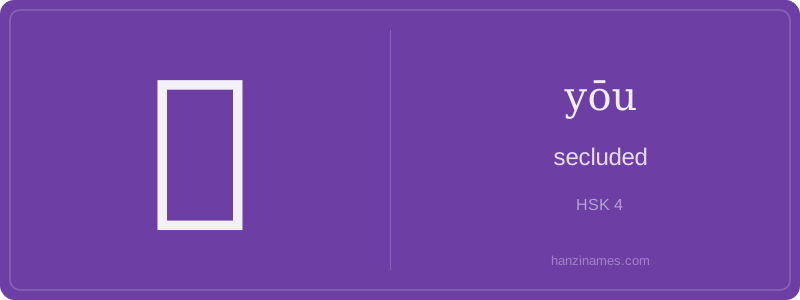
In modern Chinese, 幽 appears most frequently in literary and aesthetic contexts—not daily speech, but in poetry, place names (e.g., 幽州 Yōuzhōu, ancient northern commandery), and idioms like 幽默无声 (yōu mò wú shēng, 'profoundly silent'). It’s core to the classical concept of yōu yuǎn (‘distant profundity’), a key aesthetic ideal in Chinese landscape painting and poetry. HSK Level 4 learners encounter it in texts describing tranquil scenery or introspective moods.
The earliest attested form of 幽 appears in bronze inscriptions of the Western Zhou (c. 1046–771 BCE), where it depicts two intertwined threads (幺) beneath a roof-like element (冂), symbolizing ‘concealment within enclosure’. Later, 山 (mountain) was added, reinforcing its association with remote, inaccessible terrain—documented in the *Shuōwén Jiězì* (121 CE) as ‘deep, dark, secluded’.
As an archaeologist brushing dust from a Han dynasty bamboo slip, I find 幽 inscribed in elegant clerical script—its nine strokes whispering of secluded valleys and silent forests. The radical 幺 (yāo), meaning 'tiny' or 'minute', anchors the character, suggesting something so faint it recedes from view—like distant mist clinging to mountain folds. This isn’t mere physical remoteness; it’s the quiet weight of absence, of depth unlit by sun—a semantic stratum layered over centuries.
Excavating further, I note how 幽 evolved from early meanings of 'darkness' and 'hiddenness' into refined literary connotations: subtle elegance, profound stillness, even spiritual profundity. In the *Book of Rites*, it describes the hushed reverence of ancestral halls; in Tang poetry, it evokes moonlight filtering through bamboo groves—never just 'far away', but *intimately withdrawn*, inviting contemplation rather than conquest.
The character’s structure itself is an archaeological site: two 幺 radicals flank 山 (mountain), with 幺 repeated above and below—suggesting layers of concealment, like nested ravines. Its stroke order (starting top-left with a dot) mirrors the slow descent into silence: first the faintest trace, then enclosure, then depth. To write 幽 is to perform an act of ritual withdrawal—each stroke a step deeper into stillness, echoing Daoist and Chan Buddhist ideals long embedded in China’s cultural bedrock.
Example Sentences
Common Compounds
Similar Characters — Don't Mix These Up
Your First Step into Chinese Culture: Get a Chinese Name
Every journey into Chinese begins with a name. Use our free Chinese name generator to create a meaningful, personalized Chinese name that fits you perfectly.
Get My Chinese Name →