厕
Character Story & Explanation
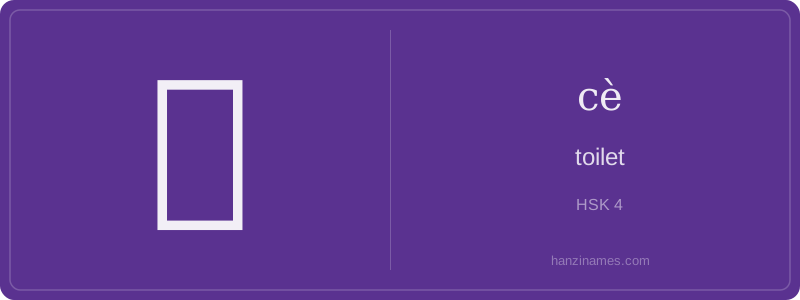
In modern China, 厕 appears ubiquitously on signage (e.g., 厕所 cèsuǒ), public facility maps, and hygiene campaigns. It rarely stands alone—almost always compounds like 厕所 or 公厕 (gōngcè, 'public toilet'). Historically, it appears in Song dynasty texts like *Dream Pool Essays* discussing urban sanitation, and Ming legal codes specifying penalties for defiling temple courtyards—where ‘defiling’ often involved improper use of outhouses.
The character is not pictographic—it evolved from seal script where 厂 (shelter) + 则 (phonetic, later semantic reinforcement) merged by the Qin standardization. No oracle bone or bronze inscriptions contain 厕; its earliest secure attestations are in Han bamboo manuscripts, confirming its late emergence as urban infrastructure expanded.
Unearthing 厕 (cè) feels like brushing dust from a Han dynasty latrine inscription—functional, unadorned, yet revealing much about ancient sanitation and social hierarchy. Its radical 厂 (hǎn), meaning 'cliff' or 'overhanging rock', originally denoted a sheltered, recessed space—a practical descriptor for an outdoor or semi-enclosed toilet structure common in early agrarian settlements.
The right side, 则 (zé), is not merely phonetic; it carries the ancient sense of 'rule' or 'standard', hinting that waste disposal was regulated even then—archaeological evidence from Mawangdui and Juyan shows official latrine maintenance records and hygiene edicts. This character thus encodes both spatial logic and administrative oversight.
Unlike ornate characters celebrating virtue or divinity, 厕 emerges from necessity: low-status, high-frequency, deeply embedded in daily ritual. Its eight-stroke form stabilizes by the Eastern Han, shedding earlier variant forms with 石 (stone) or 土 (earth) radicals—confirming a shift from pit latrines to built structures. It’s linguistic archaeology at its most pragmatic: no oracle bones, but plenty of bamboo slips.
Example Sentences
Common Compounds
Similar Characters — Don't Mix These Up
Your First Step into Chinese Culture: Get a Chinese Name
Every journey into Chinese begins with a name. Use our free Chinese name generator to create a meaningful, personalized Chinese name that fits you perfectly.
Get My Chinese Name →