式
Character Story & Explanation
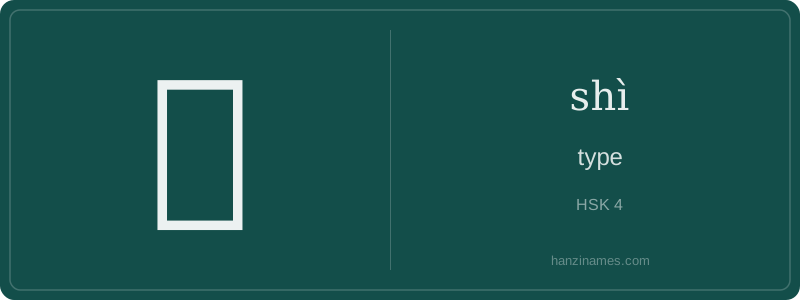
式 is ubiquitous in contemporary Chinese: it appears in official documents (格式 géshì, 'format'), tech interfaces (登录方式 dēnglù fāngshì, 'login method'), and daily speech (这种方式 zhè zhǒng fāngshì, 'this way'). It’s central to HSK 4 vocabulary and appears in idioms like ‘公式化’ (gōngshìhuà, 'to standardize') and ‘程式化’ (chéngshìhuà, 'to routinize'). Historically, 式 first appeared in seal script during the Warring States period (475–221 BCE), originally denoting 'ritual measure' or 'standard procedure' in legal and ceremonial contexts.
The character’s form derives from the radical 弋 (yì)—a hunting tether—combined with 工 (gōng, 'craft, work'), suggesting 'a measured, crafted standard'. While oracle bone inscriptions don’t preserve 式, bronze inscriptions from the late Zhou confirm its use in codified rites. Today, Chinese students memorize its six-stroke order daily—and office workers routinely select ‘字体样式’ (zìtǐ yàngshì, 'font style') in Word, embodying its enduring role as the grammar of order.
At its core, 式 (shì) reflects the Chinese worldview that reality is structured—not chaotic—but organized into discernible, repeatable patterns. Unlike Western notions of 'type' as a static category, 式 carries connotations of ritual, formality, and embodied practice: a 'way of doing' that aligns human action with cosmic or social order. This resonates in Confucian rites (礼式 lǐshì), martial arts forms (套路 tào lù), and even algorithmic logic—where ‘form’ implies both structure and correctness.
Historically, 式 appears in classical texts like the Rites of Zhou (《周礼》), where it denotes standardized ceremonial procedures essential for maintaining harmony between heaven, ruler, and people. Its philosophical weight extends to Daoist cosmology: the ‘ten thousand things’ arise from Dao’s nameless origin, yet manifest through recognizable 式—visible expressions of underlying principles. Thus, 式 is never merely descriptive; it’s normative and performative.
In modern usage, 式 preserves this duality: it names technical formats (e.g., PDF格式) while also evoking cultural authenticity (中式 cuisine, 日式 aesthetics). This reveals a deeper cultural value—the belief that meaning is inseparable from proper form. To adopt a 式 is not just to copy a template, but to enter a tradition, honor its discipline, and participate in its continuity. In China’s fast-evolving society, 式 anchors innovation in recognizability and respect for precedent.
Example Sentences
Common Compounds
Similar Characters — Don't Mix These Up
Your First Step into Chinese Culture: Get a Chinese Name
Every journey into Chinese begins with a name. Use our free Chinese name generator to create a meaningful, personalized Chinese name that fits you perfectly.
Get My Chinese Name →