弹
Character Story & Explanation
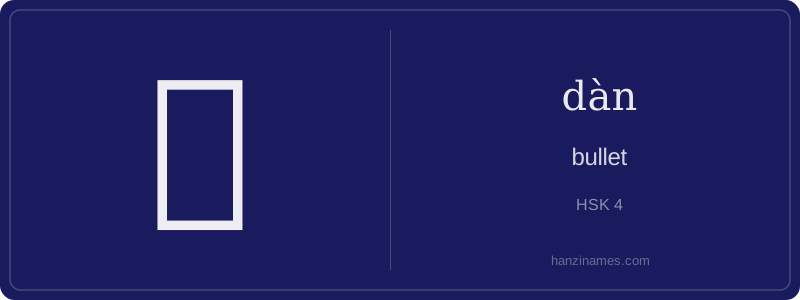
Historically, 弹 appears in military treatises like the *Wujing Zongyao* (1044 CE), where 弹丸 (dàn wán) referred to clay or iron pellets used in early gunpowder weapons—verifiably documented precursors to cannonballs. Today, it’s ubiquitous: ‘子弹’ (zǐdàn, bullet) appears in news reports, safety regulations, and HSK-4 textbooks; ‘弹窗’ (tán chuāng, pop-up window) is standard tech vocabulary. The idiom ‘弹尽粮绝’ (dàn jìn liáng jué, ‘ammunition exhausted, rations gone’) dates to Ming dynasty warfare records and remains a common metaphor for total depletion.
The character’s form is not pictographic but phono-semantic: 弓 (bow) signals meaning (projectile-related), while 単 (simplified from 單) serves as a phonetic component. No oracle-bone or bronze inscriptions survive for 弹—it first appears reliably in Han dynasty clerical script. So rather than mythic origins, think of a Beijing subway rider tapping ‘弹幕’ (dàn mù, ‘bullet curtain’—live scrolling comments on Bilibili) — that’s 弹 in its living, digital, 21st-century role.
As a detective tracing 弹’s evolution, I begin at the crime scene: the radical 弓 (bow). This isn’t coincidence—it’s evidence. In ancient China, ‘dàn’ meant a small projectile—stone or clay—fired from a bow or slingshot. The character’s left side (弓) anchors its ballistic origin; the right side (単, simplified from 單) originally conveyed ‘single’ or ‘unit’, suggesting a discrete, launched object—hence ‘crossball’: a compact, self-contained missile.
The dual pronunciation tells a tale of semantic split. tán (2nd tone) emerged as the verb form—‘to pluck’ (a string) or ‘to bounce’—metaphorically extending from the bowstring’s snap and the projectile’s rebound. This phonetic shift reflects how physical action (tension → release → recoil) birthed parallel meanings: launching *and* vibrating. Linguistic forensics confirm this duality appears consistently in early Middle Chinese texts like the *Qieyun* (601 CE).
Modern usage preserves both lineages: dàn remains the noun for projectiles (bullets, bombs, even digital ‘emojis’ in internet slang), while tán governs verbs like playing instruments or bouncing balls. The character didn’t evolve by accident—it was *designed* to hold tension, like a drawn bow: two forces (noun/verb, attack/resonance) coiled in one glyph. Its 11 strokes are not arbitrary—they’re the calibrated arc of historical logic.
Example Sentences
Common Compounds
Similar Characters — Don't Mix These Up
Your First Step into Chinese Culture: Get a Chinese Name
Every journey into Chinese begins with a name. Use our free Chinese name generator to create a meaningful, personalized Chinese name that fits you perfectly.
Get My Chinese Name →