微
Character Story & Explanation
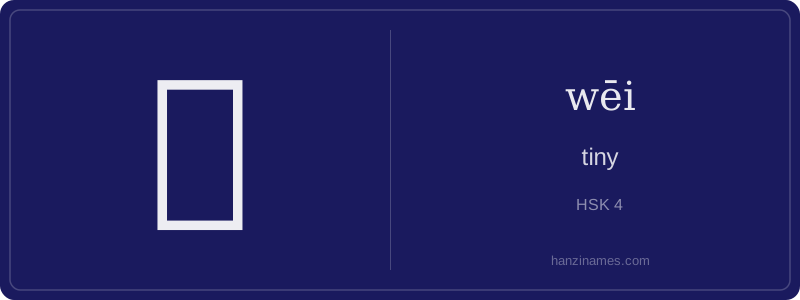
While 微 did historically denote an ancient state near Chongqing (recorded in the Zuo Zhuan and Shiji as a vassal of Chu during the Spring and Autumn period), its dominant modern usage centers on concepts of smallness and subtlety. It appears in high-frequency compounds like 微笑 (wēixiào, 'smile'), 微风 (wēifēng, 'breeze'), and the ubiquitous platform name 微信 (Wēixìn, 'WeChat'). The idiom 慎微 (shènwēi, 'be cautious about the minute')—from the Han Feizi—exemplifies its ethical weight: vigilance begins with the seemingly trivial.
The character’s form evolved from seal script, where it combined 彳 (‘walking’) with 几 (jī, ‘small table’) and 一 (horizontal line), later standardizing with 山 (mountain) and 毋 (wú, 'not') components in clerical script. Though its earliest oracle-bone form is unattested, the modern structure visually conveys ‘smallness in motion’—a walking person dwarfed by subtle topography.
The character 微 (wēi) opens a window into the Chinese worldview where significance is not always measured by scale. In classical thought, the ‘micro’—a subtle movement, a faint sound, or a minor state—holds profound resonance. Its radical 彳 (chì), meaning ‘to walk’, suggests quiet progression: influence that accumulates imperceptibly over time, like water carving stone. This reflects the Daoist and Confucian reverence for understated virtue—where true power lies in restraint, observation, and incremental change.
Historically, 微 named a small but strategically located ancient state near modern Chongqing—a reminder that geography shapes culture as much as size. Though politically modest, its location along the Yangtze placed it at a cultural crossroads, absorbing influences from Ba, Shu, and Chu civilizations. Thus, 微 embodies a core Chinese insight: centrality and consequence are not synonymous with magnitude; even the smallest entity can anchor a watershed of meaning.
In modern usage, 微 retains this layered humility—signifying ‘tiny’, ‘slight’, or ‘subtle’, yet also carrying weight in terms like 微信 (WeChat) and 微观 (microscopic analysis). It teaches that attention to the minute is not reductionism, but a disciplined form of perception. To study 微 is to practice the art of noticing what others overlook—aligning language, ethics, and epistemology in one elegant stroke-filled glyph.
Example Sentences
Common Compounds
Similar Characters — Don't Mix These Up
Your First Step into Chinese Culture: Get a Chinese Name
Every journey into Chinese begins with a name. Use our free Chinese name generator to create a meaningful, personalized Chinese name that fits you perfectly.
Get My Chinese Name →