恐
Character Story & Explanation
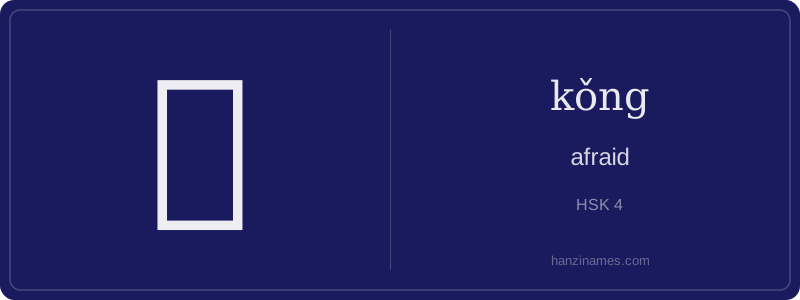
In contemporary China, 恐 is most commonly encountered in formal, medical, legal, and media contexts — never in casual speech. It appears in official terms like 恐怖主义 (kǒngbù zhǔyì, 'terrorism'), 恐慌 (kǒnghuāng, 'panic'), and clinical phrases like 社交恐惧症 (shèjiāo kǒngjù zhèng, 'social anxiety disorder'), widely reported in state media and health campaigns since the 2010s. The Ministry of Education’s HSK syllabus includes it at Level 4 precisely because learners must comprehend news, policy documents, and psychological discourse.
The character’s form is well-documented: the top part 工 (gōng, 'work') evolved from an ancient symbol representing 'to press down' or 'suppress', combined with 心 (heart/mind) below — literally 'a suppressed heart', attested in seal script (c. 3rd century BCE) and confirmed by the Shuōwén Jiězì dictionary (121 CE). This reflects fear as internal constraint, not passive feeling.
The character 恐 (kǒng) captures the visceral, heart-centered experience of fear — not just nervousness, but deep-seated dread. Its radical 心 (xīn), meaning 'heart' or 'mind', anchors the emotion in the body’s core, reflecting traditional Chinese understanding that emotions originate in the heart-mind. This contrasts with Western brain-centric models, making 恐 culturally resonant as both psychological and somatic.
Historically, 恐 appears early in classical texts like the Book of Rites (Lǐjì), where it describes ritual awe before ancestors — a reverent fear tied to morality and social order. In modern usage, it’s rarely used alone; instead, it thrives in compound words like 恐惧 (kǒngjù, 'fear') or 恐怖 (kǒngbù, 'terror'), often carrying gravity, formality, or even legal weight (e.g., anti-terrorism laws).
While beginners might associate 恐 only with 'being afraid', native speakers instantly recognize its elevated register: you’d say 害怕 (hàipà) for everyday fright ('I’m scared of dogs'), but 恐惧 when discussing phobias, trauma, or existential anxiety. Its ten-stroke structure — beginning with the 'work' component 工 (gōng) over 心 — subtly suggests fear as laborious mental exertion, a documented structural analysis in modern lexicography.
Example Sentences
Common Compounds
Similar Characters — Don't Mix These Up
Your First Step into Chinese Culture: Get a Chinese Name
Every journey into Chinese begins with a name. Use our free Chinese name generator to create a meaningful, personalized Chinese name that fits you perfectly.
Get My Chinese Name →