懒
Character Story & Explanation
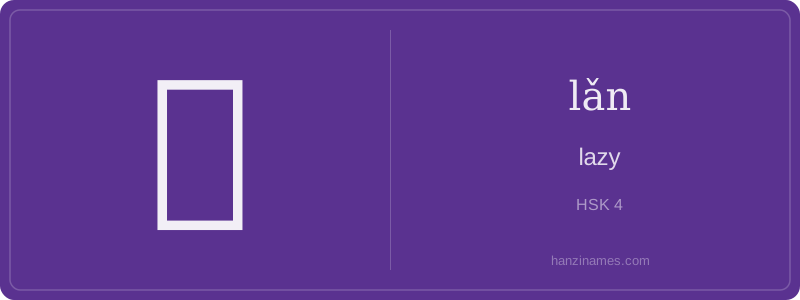
In daily Mandarin, 懒 is most commonly paired with 惰 (duò) in the compound 懒惰 (lǎnduò), a standard HSK 4 term meaning 'laziness'—used in education, parenting, and workplace feedback. It appears in the classical idiom '好吃懒做' (hào chī lǎn zuò, 'loves eating and hates working'), documented since the Ming dynasty in vernacular fiction like Water Margin. Modern usage includes playful self-deprecation ('我今天好懒' — 'I’m so lazy today') but remains socially loaded—calling someone '懒' directly is considered impolite unless among close friends.
The character’s written form has no pictographic origin; it’s a phono-semantic compound. The right side 嫩 (nèn) provides approximate sound (lǎn shares the -an rime), while 忄 conveys the mental/emotional domain. No ancient pictograph exists—its earliest verified forms appear in Song-era printed texts, confirming its status as a later lexical innovation reflecting evolving Confucian labor ethics.
Our detective work begins at the scene: the character 懒 (lǎn), a 16-stroke suspect in the case of 'moral indolence.' Its left radical 忄—'heart-mind'—immediately signals this isn’t just physical sluggishness, but an internal state: laziness as a disposition of the psyche, not merely idle limbs. The right component 嫩 (nèn) originally meant 'tender, soft'—a semantic twist where 'softness' evolved metaphorically into 'lack of firm resolve,' then crystallized into 'aversion to effort.' This psychological framing is central to how Chinese evaluates behavior—not as neutral rest, but as willful withholding of diligence.
Zooming in on historical forensics: 懒 appears reliably in Song and Ming dynasty texts—not in oracle bones or bronze inscriptions, confirming its relatively late emergence. It surfaces in moral primers like Disciples’ Rules (弟子规), where '懒惰' (lǎnduò, laziness) is explicitly condemned alongside '骄慢' (pride) and '贪欲' (greed). Crucially, it’s never used neutrally; even modern dictionaries mark it with disapproval labels like 'derogatory' or 'pejorative.' Our suspect carries cultural baggage—it’s not a descriptive term, but a verdict.
The stroke order tells its own story: starting with the heart radical (three dots + vertical stroke), then building the 'tender' component with precise, deliberate strokes—including two consecutive horizontal lines that mimic drooping shoulders. Calligraphers note that the final 'stroke 16' (a downward hook) often curves inward, visually echoing withdrawal or retreat. This isn’t accidental artistry—it’s orthographic body language: every line reinforces the meaning. Even the character’s structure invites slow, careful writing—a gentle irony for a symbol of avoidance.
Example Sentences
Common Compounds
Similar Characters — Don't Mix These Up
Your First Step into Chinese Culture: Get a Chinese Name
Every journey into Chinese begins with a name. Use our free Chinese name generator to create a meaningful, personalized Chinese name that fits you perfectly.
Get My Chinese Name →