几
Character Story & Explanation
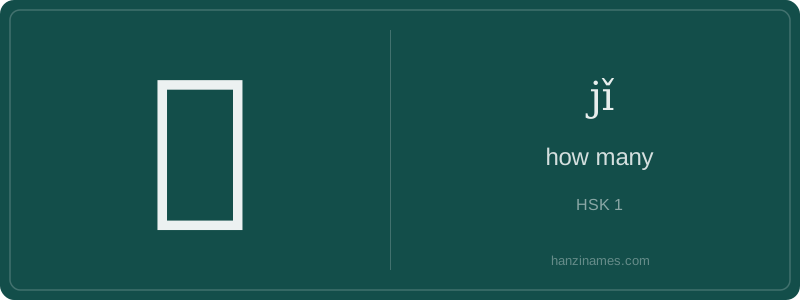
In everyday China, 几 appears constantly in spoken and written Mandarin — especially in HSK 1–2 dialogues. You’ll hear it in taxi rides ('去几个站?' — 'How many stops?'), street food stalls ('要几个包子?'), and school exams ('你今年几岁?'). It’s indispensable in the phrase 几乎 (jīhū, 'almost'), though note the tone shift to jī — a common source of learner confusion. The character also features in idioms like 几经周折 (jǐ jīng zhōuzhé, 'after several twists and turns'), reflecting its use for counting iterations or attempts.
Originally, 几 was a pictograph of a low, legless table — still visible in modern calligraphy’s curved first stroke (⺈) and horizontal base (乛). This shape is documented in bronze inscriptions (c. 11th–3rd c. BCE) and later standardized in seal script. While the ‘table’ meaning survives in jī readings (e.g., 几案, 'writing desk'), the jǐ reading for 'how many' emerged as a phonetic loan, attested in Warring States bamboo texts as an interrogative quantifier.
The character 几 (jǐ) is one of the simplest yet most frequently used interrogative and indefinite quantifiers in Mandarin. With just two strokes, it appears constantly in beginner conversations — asking about quantity, age, time, or countable items. Its compact form belies its high functional load: it’s essential for forming basic questions like 'How many?' and expressing approximation like 'a few' or 'several.' Unlike English, where 'how many' requires multiple words, 几 packs that meaning into a single, elegant glyph.
Despite its simplicity, 几 carries subtle grammatical rules. It only modifies measure words (e.g., 个, 岁, 次), never nouns directly — you say ‘几个苹果’ (jǐ gè píngguǒ), not *‘几苹果’. This measure-word dependency reflects Mandarin’s strict syntactic structure. Learners often overgeneralize, but native speakers instinctively insert the correct classifier after 几, making it a gateway to mastering Chinese grammar patterns.
Historically, 几 evolved from an ancient pictograph representing a low table or stand — a meaning preserved in its homophone 几 (jī), used in formal contexts like ‘茶几’ (chájī, ‘tea table’). But as a numeral quantifier, 几 (jǐ) has been standard since at least the Han dynasty in texts like the *Shuōwén Jiězì*, where it was defined as ‘a small number.’ Its enduring role underscores how Chinese efficiently repurposes simple forms for core grammatical functions.
Example Sentences
Common Compounds
Similar Characters — Don't Mix These Up
Your First Step into Chinese Culture: Get a Chinese Name
Every journey into Chinese begins with a name. Use our free Chinese name generator to create a meaningful, personalized Chinese name that fits you perfectly.
Get My Chinese Name →