挺
Character Story & Explanation
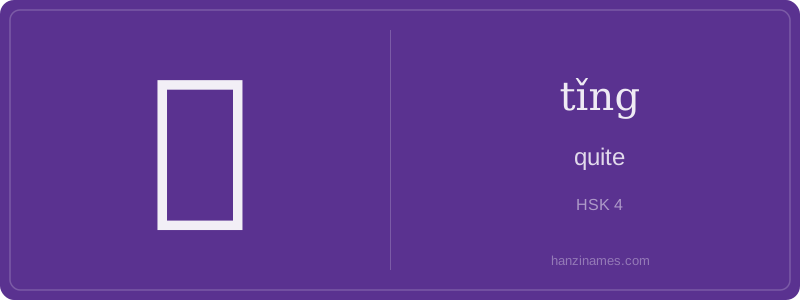
In modern Chinese daily life, 挺 is overwhelmingly used as an informal adverb meaning ‘quite’ or ‘fairly’, especially in northern dialects and colloquial speech. It appears frequently in HSK 4–5 dialogues, social media comments, and everyday conversation—e.g., ‘挺方便’ (tǐng fāngbiàn, ‘quite convenient’) or ‘挺有意思’ (tǐng yǒu yìsi, ‘quite interesting’). A well-documented idiom is 挺身而出 (tǐngshēn ér chū), meaning ‘to step forward courageously’, recorded in classical texts like the Book of Han to describe loyal ministers acting decisively.
The character 挺 is a phono-semantic compound: 扌 (hand radical) indicates action, while 廷 (tíng, ‘court’) provides sound and partial meaning—courts were places of upright conduct and formal posture. Its earliest attested form appears in bronze inscriptions of the Warring States period, depicting a person standing tall in ceremonial context—not a pictograph, but a deliberate abstraction of upright agency.
Imagine walking through Beijing’s Houhai neighborhood on a crisp autumn morning. A tai chi master stands by the lake, back perfectly upright—his spine ‘tǐng’, shoulders relaxed but posture unwavering. Locals call this bearing ‘tǐng zhe’, meaning ‘holding oneself straight’—not just physically, but with quiet dignity. The character 挺 captures that poised, resilient uprightness: not rigid like a rod, but alive and intentional, like bamboo bending slightly in wind yet never breaking.
In spoken Mandarin, 挺 is most commonly used as an adverb meaning ‘quite’ or ‘rather’—a soft intensifier conveying warm, understated approval. You’ll hear it everywhere: ‘这菜挺好吃的’ (‘This dish is quite tasty’) at a Sichuan hotpot joint, or ‘他挺努力的’ (‘He’s quite hardworking’) from a teacher praising a student. Its tone (tǐng, third tone) rises then falls, mirroring how the word adds subtle emphasis without shouting.
Though its original meaning was ‘to stretch upright’ or ‘to prop up’, 振 (zhèn) and 挺 diverged early—振 implies vigorous movement (e.g., ‘to shake’), while 挺 conveys stable, self-supported verticality. This semantic nuance echoes Confucian ideals: moral uprightness isn’t about force, but inner alignment. Even today, when someone says ‘你得挺住’ (‘You must hold on’), they’re invoking both physical endurance and emotional fortitude—a layered resonance embedded in nine clean strokes.
Example Sentences
Common Compounds
Similar Characters — Don't Mix These Up
Your First Step into Chinese Culture: Get a Chinese Name
Every journey into Chinese begins with a name. Use our free Chinese name generator to create a meaningful, personalized Chinese name that fits you perfectly.
Get My Chinese Name →