挂
Character Story & Explanation
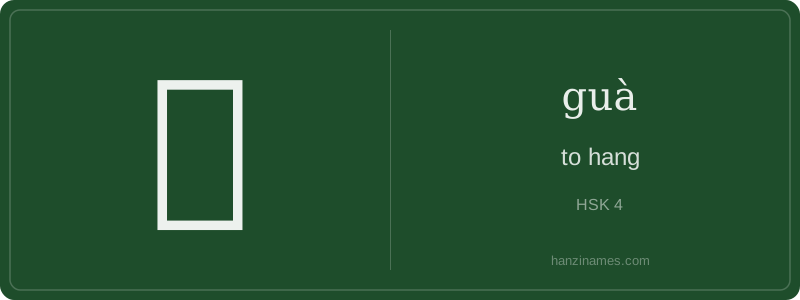
In daily life, 挂 appears constantly: shopkeepers 挂 up signs before opening, students see 挂科 on exam results, and families 挂 red envelopes during Spring Festival. A well-documented idiom is ‘挂羊头卖狗肉’ (guà yáng tóu mài gǒu ròu)—‘hang a sheep’s head but sell dog meat’—criticizing false advertising, recorded as early as the Song Dynasty (10th–13th c.) in texts like Yunlin Shihua. It remains widely used in media and satire today.
The character’s form is not pictographic but phono-semantic: 扌 (hand) + 华 (huá, phonetic, originally meaning ‘magnificent flower’). While 华 evolved graphically, its inclusion in 挂 dates to at least the Qin bamboo slips (3rd c. BCE), where it consistently served as the sound hint. No oracle-bone form exists—its earliest attestation is in seal script, showing clear hand-action semantics.
Imagine walking through Beijing’s Houhai neighborhood on a crisp autumn morning. A vendor near the lake adjusts a red lantern—carefully guàing it from a curved eave with practiced hands. The character 挂 (guà) captures that precise, intentional act: not just placing something, but securing it visibly and purposefully in space. Its 扌 (hand) radical signals human agency—this is an action done *by hand*, often with care or ceremony.
The nine strokes of 挂 flow from left to right: first the hand radical (扌), then the phonetic component 华 (huá), which hints at pronunciation while historically linking to brightness and ornamentation—fitting for objects we hang to display, like lanterns, calligraphy scrolls, or even New Year couplets. This blend of sound and meaning makes 挂 deeply functional in written Chinese.
In modern usage, 挂 extends beyond physical suspension. You ‘hang’ a phone call (挂电话), ‘hang’ a status (挂名—holding a title without duties), or even ‘hang’ a class (挂科—failing an exam, literally ‘hanging a subject’). These metaphorical extensions reveal how Chinese builds abstract concepts from tangible actions—turning the simple physics of hanging into rich linguistic texture.
Example Sentences
Common Compounds
Similar Characters — Don't Mix These Up
Your First Step into Chinese Culture: Get a Chinese Name
Every journey into Chinese begins with a name. Use our free Chinese name generator to create a meaningful, personalized Chinese name that fits you perfectly.
Get My Chinese Name →