支
Character Story & Explanation
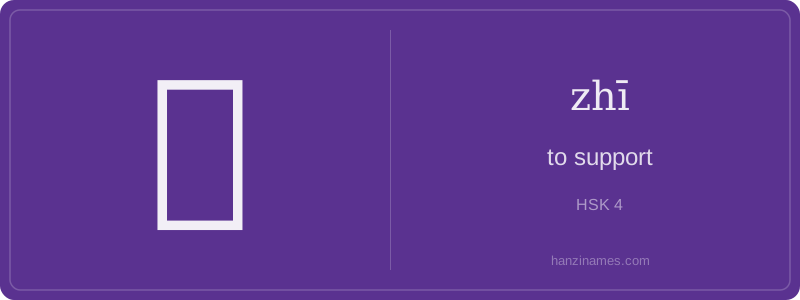
支 is widely used in modern Mandarin for verbs meaning 'to support', 'to fund', or 'to prop up', especially in formal, institutional contexts. It appears in HSK-4 vocabulary like 支持 (zhīchí, 'to support'), 支援 (zhīyuán, 'to aid'), and 资助 (zīzhù, 'to sponsor'). A well-documented usage is in government policy documents—e.g., the phrase '支持中小企业发展' ('support the development of SMEs') appears repeatedly in State Council white papers since 2003.
The character’s earliest attested form appears in Warring States bamboo slips (4th c. BCE) as a simplified depiction of a hand (又) holding up a branch-like element—reflecting its core semantic field of 'propping'. While not a pure pictograph, its structure consistently conveys vertical assistance: the top stroke suggests extension upward, the lower three strokes imply grounded stability.
The character 支 (zhī) embodies a quiet, structural form of support—neither forceful nor emotional, but steady and functional. In Chinese worldview, 'support' is rarely about dominance or rescue; it’s about enabling balance: a branch holding up fruit, a pillar sustaining a roof, a policy propping up rural education. This reflects the Confucian ideal of *jūnzi* (gentleman) as a stabilizing force—not commanding, but upholding harmony through reliable presence.
Its minimal four strokes belie deep relational thinking: support is not solitary action but embedded responsibility—between generations, institutions, and nature. The character appears in words like 支援 (zhīyuán, 'aid') and 支持 (zhīchí, 'support'), both implying active, often collective, sustenance. Unlike English ‘support’ which can be abstract or passive, 支 carries an implicit physicality—like a hand steadying a wobbling vase or bamboo stakes guiding young trees upward.
This rootedness in tangible action mirrors China’s civilizational emphasis on practical virtue: moral worth is measured less in declarations than in what one *holds up*. When a village elder ‘supports’ a scholarship fund (资助, zīzhù), or a tech firm ‘backs’ green innovation (支持), the character evokes quiet infrastructure—not spotlighted heroism, but the unseen beams that keep society upright. Support, here, is stewardship made visible.
Example Sentences
Common Compounds
Similar Characters — Don't Mix These Up
Your First Step into Chinese Culture: Get a Chinese Name
Every journey into Chinese begins with a name. Use our free Chinese name generator to create a meaningful, personalized Chinese name that fits you perfectly.
Get My Chinese Name →