败
Character Story & Explanation
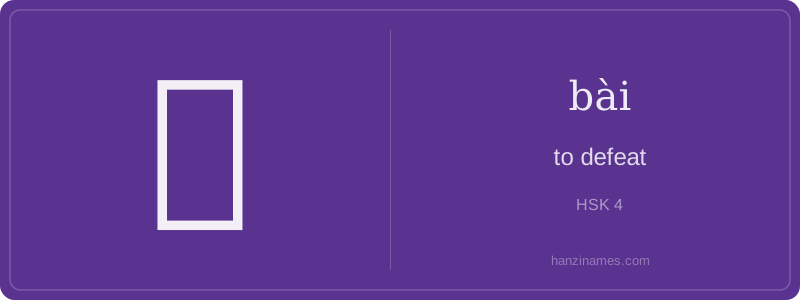
败 is ubiquitous in modern Chinese media and daily speech: news headlines report economic ‘failures’ (经济失败), sports commentators analyze team ‘defeats’ (失利/败北), and parents gently tell children ‘don’t fear failing’ (不怕失败). A cornerstone idiom is 一败涂地 (yī bài tú dì)—‘utterly defeated, lying prostrate on the ground’—documented since the Han dynasty in Sima Qian’s *Records of the Grand Historian*, describing Xiang Yu’s final loss. It remains widely used today to express catastrophic failure.
The character’s form is not pictographic but phono-semantic: the left radical 贝 (bèi) denotes ‘valuables’ or ‘wealth’, signaling loss of value or resources; the right component 攵 (pū, variant of 攴) means ‘to strike’ or ‘to act decisively’. Together, they convey ‘a decisive blow causing loss’—a meaning stable since the seal script era (c. 3rd century BCE), confirmed by excavated Qin bamboo texts.
The character 败 (bài) embodies a profound cultural acknowledgment that defeat is not merely failure, but a pivotal, instructive moment in the cycle of effort and growth. In traditional Chinese thought—rooted in Daoist balance and Confucian self-cultivation—loss is rarely seen as absolute or shameful; rather, it signals misalignment with virtue, strategy, or timing. This reflects the worldview that success and failure are interdependent, like yin and yang: one cannot exist without the other’s defining presence.
Historically, military classics like Sun Tzu’s *The Art of War* emphasize knowing when to retreat or yield—not as surrender, but as strategic wisdom. 败 thus carries moral weight: losing through arrogance or recklessness is condemned, while losing with integrity and insight may even earn respect. The character subtly reminds learners that Chinese language encodes ethics into grammar and lexicon, where verbs carry philosophical consequences.
Moreover, 败 appears in contexts far beyond warfare—business setbacks, academic reversals, relationship breakdowns—yet consistently invites reflection over blame. Its radical 贝 (bèi), meaning ‘shell’ (an ancient form of currency), hints at material loss, but the phonetic component 贝 + 攵 (a variant of 攴, ‘to strike’) suggests an action that disrupts value. Thus, 败 isn’t passive collapse—it’s an active, consequential event demanding response and recalibration.
Example Sentences
Common Compounds
Similar Characters — Don't Mix These Up
Your First Step into Chinese Culture: Get a Chinese Name
Every journey into Chinese begins with a name. Use our free Chinese name generator to create a meaningful, personalized Chinese name that fits you perfectly.
Get My Chinese Name →