午
Character Story & Explanation
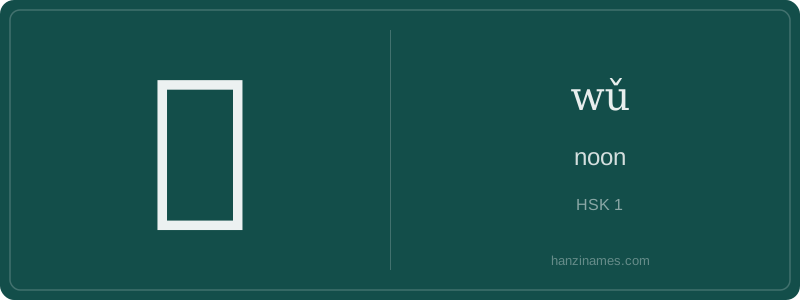
In contemporary China, 午 appears ubiquitously in daily life: on restaurant menus ('午市 special'), office schedules ('午休时间: 12:00–13:00'), and public transport announcements ('午间高峰'). It's central to the phrase 午时三刻 (wǔshí sān kè), a precise historical time marker (≈11:45 a.m.) used in imperial decrees and traditional storytelling. The idiom 马到成功 (mǎ dào chéng gōng) isn’t linked—but 午 is essential in 午夜 (wǔyè, 'midnight', lit. 'noon-night'), showing its role in temporal compound formation.
Documented origin: 午 is not a pictograph but a phono-semantic character. Its earliest attested form appears in Warring States bamboo slips (475–221 BCE) as a variant of 仵, later standardized under Qin script. The modern shape reflects sound borrowing (wǔ) and semantic association with midday—no solar pictogram exists. Today, Chinese students write 午 during primary school calligraphy drills, emphasizing its balanced stroke order: horizontal → vertical → left diagonal → right diagonal.
The character 午 (wǔ) is a foundational HSK Level 1 character representing 'noon' or 'midday'—the peak of the sun’s arc, when shadows are shortest and energy feels most intense. Its four-stroke structure is deceptively simple: a horizontal line, a vertical stroke crossing it, then two short diagonal strokes forming an 'X'-like shape. Though it shares the 十 (shí, 'ten') radical, 午 is not numerically related; instead, it evolved as a phonosemantic compound tied to timekeeping in ancient Chinese calendrical systems.
Historically, 午 corresponds to the seventh of the twelve Earthly Branches—a cyclical system used since the Shang Dynasty (c. 1600–1046 BCE) for time, astrology, and zodiacal years. In this system, 午 governs the hours from 11 a.m. to 1 p.m., the hottest and most yang-rich period of the day. This association persists in modern Mandarin, where 午 appears in time expressions, meal names, and cultural concepts like the 'noon break' tradition still observed across China.
Visually, 午 stands out for its symmetry and balance—two diagonal strokes cradling the central cross, evoking the sun at its zenith. Learners often confuse it with 十 (shí) or 牛 (niú), but its distinct diagonal strokes and lack of horizontal base set it apart. Mastering 午 unlocks access to essential vocabulary like 午饭 (wǔfàn, 'lunch') and 午休 (wǔxiū, 'noon nap'), both deeply embedded in daily rhythm and workplace culture across urban and rural China.
Example Sentences
Common Compounds
Similar Characters — Don't Mix These Up
Your First Step into Chinese Culture: Get a Chinese Name
Every journey into Chinese begins with a name. Use our free Chinese name generator to create a meaningful, personalized Chinese name that fits you perfectly.
Get My Chinese Name →