景
Character Story & Explanation
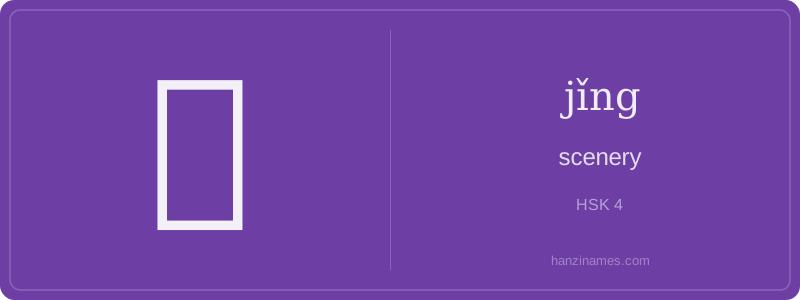
景 is ubiquitous in daily Chinese: from tourism slogans like ‘美丽风景’ (beautiful scenery) to news headlines like ‘经济形势严峻,但前景乐观’ (economic situation is tough, but the outlook is optimistic). It appears in HSK 4 vocabulary such as 风景 (fēngjǐng, landscape), 情景 (qíngjǐng, scene/situation), and 背景 (bèijǐng, background). The idiom ‘好景不长’ (hǎo jǐng bù cháng)—‘good times don’t last’—has been documented since the Ming dynasty in vernacular literature, reflecting a philosophical awareness of impermanence.
Historically, 景 first appeared in bronze inscriptions (c. 1000 BCE) as a compound of 日 (sun) and 京 (capital city, later stylized), suggesting 'the light over the capital'—a luminous, elevated place worthy of reverence. By the Han dynasty, it was standardly used for both physical vistas and figurative 'prospects', cementing its dual role as visual and conceptual horizon.
The character 景 (jǐng) embodies the Chinese worldview that scenery is never passive background—it is a dynamic interplay of light, time, and human perception. Rooted in the sun radical 日, it evokes how daylight reveals form and mood: dawn mist over mountains, autumn leaves lit by low sun, or city lights at dusk. In classical poetry and painting, ‘scenery’ is always imbued with qì (vital energy) and emotional resonance—what you see reflects what you feel.
This character reflects the Confucian and Daoist harmony between humanity and nature: scenery is not conquered or merely observed, but entered into relationship with. A 'good view' is not just visually pleasing but morally and spiritually clarifying—hence 景 also means 'revered example' or 'illustrious reputation', extending the idea of 'what stands out in the light' to moral excellence.
Even in modern usage, 景 carries layered temporality: it can mean 'scene' (a moment frozen in time), 'view' (a spatial perspective), or 'situation' (a socio-historical condition). This semantic richness mirrors the Chinese understanding of reality as relational and context-dependent—not fixed objects, but shifting configurations of light, position, and meaning.
Example Sentences
Common Compounds
Similar Characters — Don't Mix These Up
Your First Step into Chinese Culture: Get a Chinese Name
Every journey into Chinese begins with a name. Use our free Chinese name generator to create a meaningful, personalized Chinese name that fits you perfectly.
Get My Chinese Name →