材
Character Story & Explanation
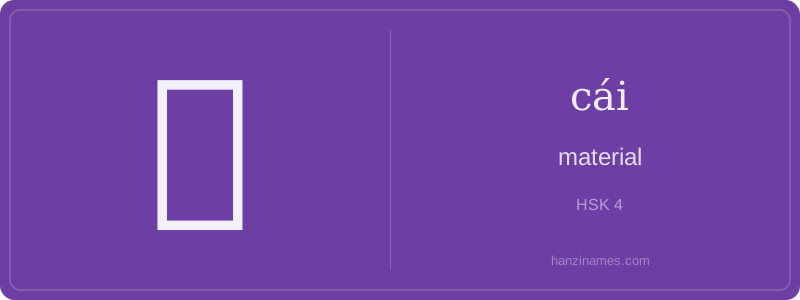
材 appears frequently in daily life — from construction sites (建材 jiàncái, 'building materials') to HR departments (人才市场 réncái shìchǎng, 'talent market'). It features in the enduring idiom 量才录用 (liàng cái lùyòng), meaning 'appoint people according to their abilities,' codified in imperial civil service exams and still cited in leadership training. Historically, the term 木材 (mùcái) appears in Tang dynasty tax records listing timber quotas, confirming its bureaucratic and economic centrality.
材 is a phono-semantic compound: left radical 木 (wood, semantic) + right phonetic component 才 (cái, indicating pronunciation). Unlike ancient pictographs, it first appears in standardized seal script (c. 3rd century BCE), not oracle bones — reflecting its later emergence as wood became systematized in statecraft and craft. Today, Chinese students learn it early in HSK 4 as part of core vocabulary for discussing resources, talent, and infrastructure.
The character 材 (cái) embodies a foundational Chinese worldview: that value arises not from abstract ideals alone, but from the tangible, usable essence of things. Its radical 木 (wood) anchors it in nature — wood being humanity’s earliest, most versatile raw material — while the right-hand component 財 (simplified here to 才) subtly evokes capability and potential. This fusion reflects the Confucian and Daoist emphasis on practical virtue: a person or resource is valued not for mere existence, but for *fitness for purpose*.
In classical thought, 材 carries moral weight — Mencius spoke of ‘cultivating one’s innate talents’ (材), implying that human potential, like timber, must be recognized, shaped, and applied wisely. The character thus bridges physical substance and ethical capacity: a good ruler must discern capable people (人才 réncái) just as a carpenter selects straight, strong wood (木材 mùcái). Materiality is never neutral; it is imbued with responsibility.
This worldview persists in modern usage: ‘material’ in Chinese rarely means inert stuff — it implies *functionality*, *readiness*, or *qualification*. A ‘qualified teacher’ is 教学材料 (jiāoxué cáiliào) — literally ‘teaching material’ — where the teacher *is* the living material of education. Even in AI ethics discussions today, scholars invoke 材 to ask: ‘What kind of human capacities are we cultivating — and for what ends?’ Thus, 材 quietly encodes a civilizational priority: utility grounded in integrity, growth rooted in nature.
Example Sentences
Common Compounds
Similar Characters — Don't Mix These Up
Your First Step into Chinese Culture: Get a Chinese Name
Every journey into Chinese begins with a name. Use our free Chinese name generator to create a meaningful, personalized Chinese name that fits you perfectly.
Get My Chinese Name →