格
Character Story & Explanation
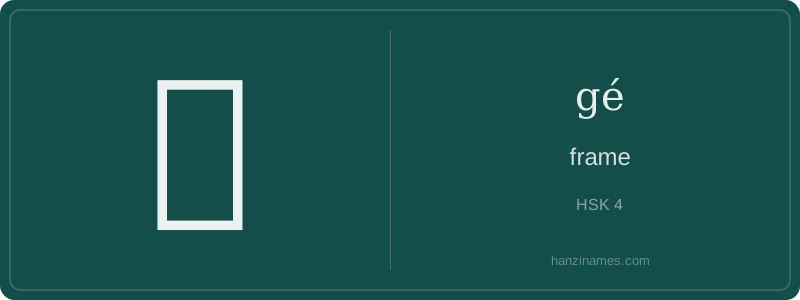
格 appears in foundational classical texts like the Great Learning (Dà Xué), where ‘ge wu zhi zhi’ (格物致知) — ‘investigating things to extend knowledge’ — became a cornerstone of Neo-Confucian epistemology. Today, it’s ubiquitous: ‘gé’ is used in ‘gémìng’ (revolution, literally ‘change of framework’), ‘gé lǜ’ (regulation), and ‘pǐn gé’ (character/moral quality). The idiom ‘bù hé gé’ (不合格) — ‘not up to standard’ — is heard daily in schools, factories, and job interviews across China.
The character is not pictographic; its earliest attested form (in seal script, c. 3rd century BCE) shows the wood radical (木) left and ‘gè’ (各, ‘each’) right — indicating classification or specification *within* a material system. No oracle bone form survives, confirming its later development as a semantic-phonetic compound, not a primal pictograph.
The character 格 (gé) embodies the Chinese philosophical reverence for order, structure, and measured harmony. Literally rooted in the ‘wood’ radical (木), it evokes the carpenter’s grid — a physical lattice used to align beams, carve timber, and frame space. This reflects a worldview where morality, knowledge, and even self-cultivation must be ‘framed’ by principle: Confucian texts speak of ‘ge wu zhi zhi’ (investigating things to extend knowledge), treating reality as a structured lattice to be understood through disciplined observation.
Historically, 格 evolved beyond geometry into ethics and classification. In imperial examinations and legal codes, ‘ge’ denoted official ranks and standardized criteria — not arbitrary rules, but calibrated measures like grid lines on a scroll. The character thus bridges the tangible (a bamboo grid for drying ink) and the abstract (moral boundaries). Its ten-stroke form mirrors balance: four strokes for the wood radical, six for the ‘each’ component (各), suggesting ‘each thing in its proper place’.
In modern life, 格 persists as a quiet architect of Chinese cognition — from smartphone grid icons to academic ‘grading standards’ (评分标准, píngfēn biāozhǔn). Even the phrase ‘ge diao’ (格调, style/tone) implies aesthetic framing: not raw expression, but artistry disciplined by cultural lattice. To master 格 is to understand that in Chinese thought, freedom thrives not outside structure, but precisely within its well-proportioned, wooden frame.
Example Sentences
Common Compounds
Similar Characters — Don't Mix These Up
Your First Step into Chinese Culture: Get a Chinese Name
Every journey into Chinese begins with a name. Use our free Chinese name generator to create a meaningful, personalized Chinese name that fits you perfectly.
Get My Chinese Name →