棵
Character Story & Explanation
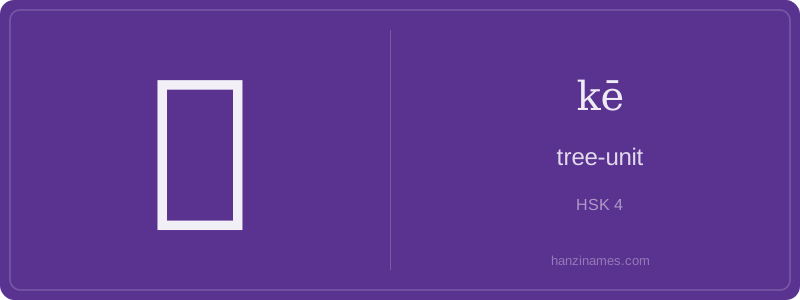
In modern Mandarin, 棵 is exclusively a measure word—never a standalone noun—and appears ubiquitously in agriculture, urban planning, and daily speech. It’s mandatory in official contexts: China’s National Forestry and Grassland Administration reports tree-planting statistics using 棵 (e.g., ‘2.3 billion棵’ annually). It’s also embedded in common phrases like ‘一棵树’ (yī kē shù, 'a tree') and appears in the idiom ‘一棵草,一滴露’ (a blade of grass, a drop of dew), emphasizing individual worth within nature.
Graphically, 棵 is a phono-semantic compound: left side 木 (radical, meaning ‘tree’) + right side 可 (sound component, kě → kē, with tone shift). First attested in the *Kangxi Dictionary* (1716), it shows no oracle bone or bronze script forms—it emerged later, likely during the Northern and Southern Dynasties, as vernacular classifiers became standardized in written records.
As an archaeologist brushing dust from a Tang-dynasty bamboo slip, I found 棵 inscribed beside a tax record listing ‘three棵 mulberry trees’—not as a noun, but as a quiet, precise unit of count. Its presence reveals how early Chinese bureaucracy required granular measurement of cultivated life: not just *how many* trees, but *how many individual, rooted, living specimens*. This wasn’t poetic abstraction—it was land surveying, silk production accounting, and ecological management in ink.
The character’s radical 木 (wood/tree) anchors it firmly in the botanical realm, while the right component, 可 (kě), originally denoted ‘to approve’ or ‘to be permissible’—suggesting sanctioned, officially recognized units. In Song-era agricultural manuals like *Chen Fu’s Farming Book*, 棵 appears repeatedly in planting guidelines: ‘one棵 per three chi of space’, revealing its role in standardizing horticultural practice across imperial domains.
Unlike generic classifiers like 个 (gè), 棵 carries silent semantic weight: it implies verticality, rootedness, and biological autonomy. A sapling, a century-old ginkgo, or even a cabbage plant—all share this classifier because they stand *upright from soil*, with a discernible trunk or core stem. That shared morphology, not taxonomy, defines its use. This is linguistic botany fossilized in script: a classifier born not of grammar books, but of farmers’ eyes scanning orchards and fields.
Example Sentences
Common Compounds
Similar Characters — Don't Mix These Up
Your First Step into Chinese Culture: Get a Chinese Name
Every journey into Chinese begins with a name. Use our free Chinese name generator to create a meaningful, personalized Chinese name that fits you perfectly.
Get My Chinese Name →