概
Character Story & Explanation
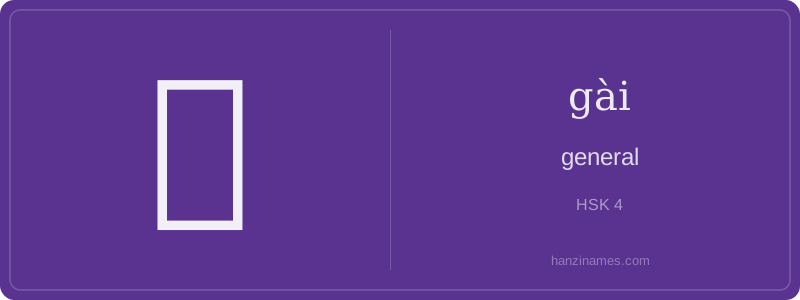
概 is widely used in formal and educational Chinese: it appears in HSK 4 textbooks, government white papers (e.g., 国民经济和社会发展概况), and university course syllabi (e.g., ‘课程概况’). A well-documented phrase is 概念 (gàiniàn, 'concept'), one of the most frequent abstract nouns in Mandarin. The idiom 大概如此 (dàgài rúcǐ, 'roughly so') has been recorded in Qing-dynasty vernacular literature and remains common in spoken Mandarin today.
The character’s form does not originate as a pictograph. Its earliest attestation is in seal script (c. 3rd century BCE), where it combines 木 (radical, likely phonetic placeholder) and 既 (jì, now obsolete phonetic component). Modern scholars agree the 木 radical here is non-semantic—it was retained for orthographic consistency, not meaning. Today, Chinese people encounter 概 daily in weather reports (‘气温大概20度’), news summaries, and app interfaces labeled ‘概况’.
The Chinese character 概 (gài) conveys the idea of 'general' or 'approximate'—capturing broad strokes rather than fine details. It reflects a deeply embedded cultural preference in Chinese thought for holistic understanding: prioritizing patterns, context, and overarching principles before diving into specifics. This aligns with classical traditions like Confucian emphasis on 'the big picture' in governance and Daoist acceptance of imprecision as part of natural flow.
In modern usage, 概 appears frequently in academic, administrative, and journalistic contexts where summarization and estimation are essential—e.g., 概述 (gàishù, 'overview') or 概率 (gàilǜ, 'probability'). Unlike English terms such as 'general'—which can imply vagueness or lack of rigor—概 carries neutral-to-positive connotations of intelligent simplification and pragmatic clarity.
Western equivalents like 'general', 'broad', or 'approximate' often carry subtle judgments: 'general' may suggest oversimplification; 'approximate' hints at inaccuracy. In contrast, 概 is linguistically and culturally normalized as a legitimate mode of reasoning—seen in official documents, news headlines, and even math education. Its radical 木 (wood/tree) is historical artifact, not semantic clue; the character evolved phonetically from ancient forms linked to 'to cover' or 'to summarize', underscoring function over literal imagery.
Example Sentences
Common Compounds
Similar Characters — Don't Mix These Up
Your First Step into Chinese Culture: Get a Chinese Name
Every journey into Chinese begins with a name. Use our free Chinese name generator to create a meaningful, personalized Chinese name that fits you perfectly.
Get My Chinese Name →