桥
Character Story & Explanation
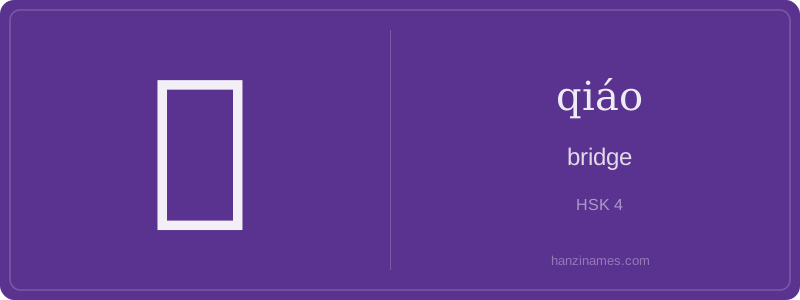
In modern Chinese, 桥 appears daily in transportation signage (e.g., 立交桥 lìjiāoqiáo — ‘overpass’), tech metaphors (网络桥接 wǎngluò qiáojiē — ‘network bridging’), and idioms like 过河拆桥 (guò hé chāi qiáo — ‘to burn one’s bridges’), documented since the Ming dynasty in vernacular novels like *Jin Ping Mei*. It’s also central to historic landmarks: the 12th-century Lugou Bridge (卢沟桥) gained global recognition after the 1937 Marco Polo Bridge Incident—a pivotal event in modern Chinese history.
The character is not pictographic in origin. Its earliest verified form appears in Han-era clerical script, where 木 (wood) combines with 乔 (originally meaning ‘tall’ or ‘elevated’) as a semantic-phonetic compound. There’s no oracle bone or bronze inscription evidence—so rather than reconstructing lost imagery, observe how Beijing residents today say ‘走桥’ (zǒu qiáo) during Lantern Festival, literally ‘walking across bridges’, a centuries-old custom for health and luck.
As an archaeologist brushing dust from a Han dynasty bamboo slip, I find 桥 not as a static symbol—but as a structural revelation. Its left side, 木 (mù), is the enduring timber of ancient beam bridges spanning the Yellow River; its right side, 乔 (qiáo), originally depicted a tall, bent tree—evolving into a phonetic component signaling height and elevation, mirroring how early Chinese bridges rose above floodplains. This duality—material + function—anchors the character in pragmatic engineering, not myth.
Excavations at Luoyang’s Eastern Han capital unearthed inscriptions where 桥 appears in municipal records: ‘修桥补路’ (repair bridges and mend roads)—a recurring administrative phrase proving bridges were state-maintained infrastructure by 1st century CE. Unlike poetic or religious glyphs, 桥 carries bureaucratic weight: it names actual crossings documented in tax rolls and garrison logs, reflecting imperial concern for transport, trade, and troop movement.
Under magnification, the 10-stroke composition reveals deliberate balance: four strokes for the wood radical (signifying construction material), six for 乔 (encoding both sound and the vertical lift essential to crossing water or ravines). No oracle bone form survives—its earliest attestation is in clerical script on Western Han wooden tablets—suggesting it emerged with large-scale civil works, not ritual practice. This makes 桥 a linguistic artifact of China’s infrastructural awakening.
Example Sentences
Common Compounds
Similar Characters — Don't Mix These Up
Your First Step into Chinese Culture: Get a Chinese Name
Every journey into Chinese begins with a name. Use our free Chinese name generator to create a meaningful, personalized Chinese name that fits you perfectly.
Get My Chinese Name →