款
Character Story & Explanation
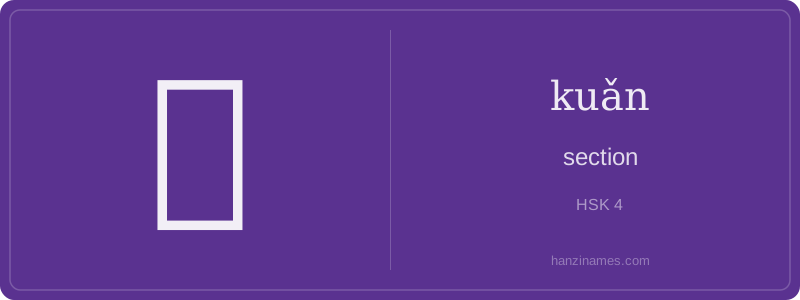
In modern Chinese, 款 appears constantly in official and transactional life: legal statutes (e.g.,《民法典》第586条第2款 — 'Article 586, Paragraph 2 of the Civil Code'), bank transfer forms ('付款人' and '收款人' fields often list '款项' — 'funds'), and even e-commerce order details ('商品款式' — 'product style/variant'). A well-known phrase is 款式 (kuǎnshì), meaning 'style/design' — used daily for clothing or furniture aesthetics.
The character’s form evolved from seal script; the right side 欠 is a documented phonetic component (not semantic here), while the left side originally depicted an altar or ritual object (now stylized as 士+示). There’s no oracle-bone evidence for 款 — it emerged later, during the Warring States period, primarily in bronze inscriptions denoting formal declarations or stipulations.
Hi students! The character 款 (kuǎn) is a Level 4 HSK word — it’s common in formal and written Chinese. While its basic dictionary meaning is 'section' (like a section of a document or law), it carries richer nuances: it often refers to a clearly defined clause, item, or provision — especially in legal, financial, or administrative contexts. Think of it like numbered paragraphs in a contract: each one is a 款.
Don’t confuse 款 with generic words for 'part' like 部 or 部分. 款 implies structure, officiality, and enumeration — you’ll see it in laws (e.g., 'Article 3, Paragraph 2'), invoices (payment items), or product specifications. Its radical 欠 (qiàn, 'to lack') may seem puzzling, but historically it relates to the idea of 'presenting something formally' — as in offering or stating terms clearly.
As a beginner, focus first on recognizing 款 in compound words like 条款 (tiáokuǎn, 'clause') or 付款 (fùkuǎn, 'make payment'). Note that it’s pronounced kuǎn — not 'kuan' with flat tone! The third tone means your voice dips then rises, like asking a gentle question. Practice writing it with its 12 strokes — start with the left-side ‘士’-like top, then the ‘示’-like middle, and finish with the right-side ‘欠’.
Example Sentences
Common Compounds
Similar Characters — Don't Mix These Up
Your First Step into Chinese Culture: Get a Chinese Name
Every journey into Chinese begins with a name. Use our free Chinese name generator to create a meaningful, personalized Chinese name that fits you perfectly.
Get My Chinese Name →