母
Character Story & Explanation
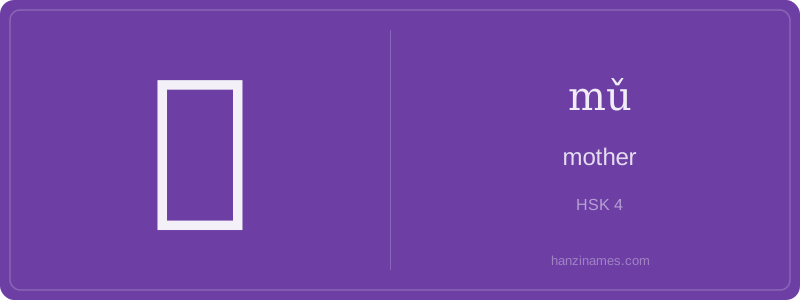
母 is used daily across mainland China, Taiwan, and overseas Chinese communities in family addresses (e.g., ‘致母亲’ — 'To Mother'), official forms (e.g., ‘母亲姓名’ — 'Mother’s Name'), and educational materials. It appears in key idioms like 孟母三迁 (Mèng Mǔ Sān Qiān), referencing Mencius’s mother who moved three times for her son’s education—a historically attested story from the *Liezi* and *Han Shu*, symbolizing maternal sacrifice and pedagogical influence.
Archaeologically, 母 first appears in bronze inscriptions (c. 11th–3rd century BCE) as a stylized pictograph of a woman with prominent breasts, later simplified in seal script. By the Han dynasty, its form stabilized into the modern five-stroke shape—still retaining the central dot (representing a nipple) and two horizontal strokes (arms or torso)—a documented evolution confirmed by paleographic studies (e.g., Qiu Xigui’s *Chinese Writing*).
The Chinese character 母 (mǔ) means 'mother' and is one of the most foundational kinship terms in Mandarin. Unlike English’s gender-neutral 'parent', 母 specifically denotes the biological or social mother, carrying deep cultural weight tied to Confucian values of filial piety (xiào). It appears in formal documents, family registers, and honorifics like 母亲 (mǔqīn), emphasizing respect and emotional gravity—not just biological relation.
In contrast to Western individualism—where 'mother' often centers on personal identity or choice—Chinese usage of 母 is embedded in relational hierarchy and intergenerational duty. For example, Mother’s Day in China (May 12) is widely observed, yet expressions of gratitude often emphasize sacrifice and endurance rather than affection alone. The term also extends metaphorically: 母语 (mǔyǔ) means 'mother tongue', underscoring linguistic inheritance as inseparable from maternal lineage.
This character reflects how Chinese conceptualizes motherhood not as a role among many, but as an irreplaceable axis of moral and cultural continuity. Its radical (also 母) signals semantic self-containment—no other component modifies its core meaning. While English may use 'mom', 'mama', or 'mother' with shifting register, 母 remains consistently formal and reverent in written contexts, rarely appearing in casual slang. That stability mirrors the enduring cultural ideal of maternal devotion in Chinese society.
Example Sentences
Common Compounds
Similar Characters — Don't Mix These Up
Your First Step into Chinese Culture: Get a Chinese Name
Every journey into Chinese begins with a name. Use our free Chinese name generator to create a meaningful, personalized Chinese name that fits you perfectly.
Get My Chinese Name →