永
Character Story & Explanation
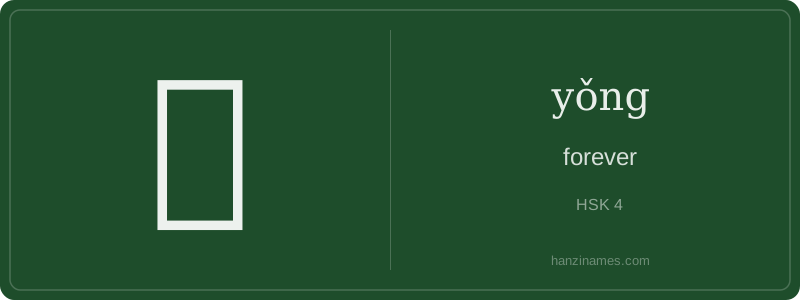
In daily life, 永 appears ubiquitously in formal, solemn, or aspirational contexts: official documents (e.g., 永久产权 'permanent property rights'), wedding vows (永结同心 'eternally united in heart'), and patriotic slogans (如:永远跟党走 'forever follow the Party'). It’s frequent in classical idioms like 永垂不朽 ('eternally immortal', used on memorials) and 永不放弃 ('never give up'), a motto widely adopted in education and sports.
The character’s earliest attested form appears in Western Han bamboo slips (2nd c. BCE), where it consistently writes the word yǒng meaning 'perpetual'. Though its seal-script origin is debated, scholars agree it evolved from a variant of 汜 (a river name) with semantic extension to 'unending flow' → 'eternity'. No oracle bone form exists—it entered the script system fully formed in early clerical script.
As an archaeologist sifting through layers of Chinese script, I trace 永 (yǒng) not to oracle bones—but to the Han dynasty’s calligraphic revolution. Its five-stroke form appears fully matured in clerical script (lìshū) inscriptions on stone steles, where it already carried the abstract sense of ‘enduring without cessation’. Unlike pictographs tied to concrete objects, 永 emerged as a phonosemantic compound: its water radical (氵, derived from 水) hints at continuity—like an unbroken flow—while the right side (永’s original seal-script shape) provided phonetic grounding.
This character was never a picture of eternity; it was engineered for meaning. By the Tang dynasty, calligraphers revered 永 as the ‘character of eight principles’ (永字八法), dissecting its strokes to teach all fundamental brush techniques—dot, horizontal, vertical, hook, rising stroke,捺 (nà), and more. Each stroke became a fossilized lesson in movement and balance, embedding philosophical weight into physical form.
What makes 永 archaeologically compelling is its stability: unlike many characters that morphed across scripts, 永’s structure remained virtually unchanged from Han clerical to modern standard script. Its resilience mirrors its semantics—‘forever’ made manifest in orthography. Even today, when students practice calligraphy, they begin with 永—not as vocabulary, but as a ritual of continuity, echoing millennia of disciplined transmission.
Example Sentences
Common Compounds
Similar Characters — Don't Mix These Up
Your First Step into Chinese Culture: Get a Chinese Name
Every journey into Chinese begins with a name. Use our free Chinese name generator to create a meaningful, personalized Chinese name that fits you perfectly.
Get My Chinese Name →