况
Character Story & Explanation
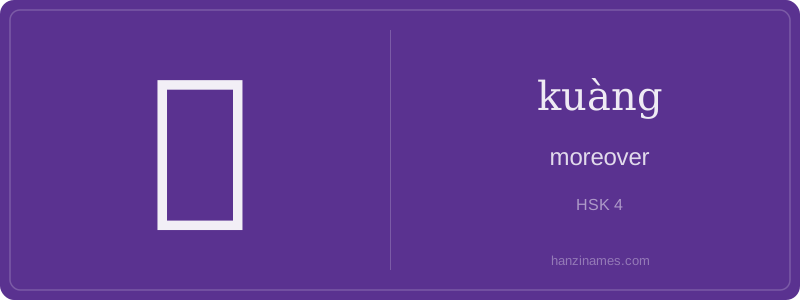
况 is most commonly used in classical and modern written Chinese within set phrases like 况且 ('moreover') and 何况 ('let alone'), both deeply embedded in formal discourse, textbooks, and media. It rarely stands alone — you won’t hear someone say '况!' in conversation. Historically, 况 appears in pre-Qin texts like the *Zuo Zhuan*, where it introduces concessive or emphatic clauses. Today, it’s indispensable in HSK 4+ exams and academic writing.
The character’s form evolved from seal script; the left 冫 is a simplified remnant of 氷 (ice), historically indicating clarity or sharpness of logic — not temperature. The right side 兄 was adopted for its sound (ancient pronunciation approximated *kʰʷaŋ*), not meaning. No pictographic origin survives; it’s a phono-semantic compound documented since the Han dynasty.
Hi students! Let’s learn 况 (kuàng), a useful conjunction meaning 'moreover', 'furthermore', or 'what’s more'. It’s not a standalone word but appears mainly in formal writing and speech to add emphasis or contrast — like saying 'and on top of that...' in English. Though it looks simple (just 7 strokes!), its power lies in connecting ideas logically. You’ll see it often in essays, news reports, and HSK 4–5 reading passages.
This character belongs to the 冫 (bīng) radical — the 'ice' radical — which hints at coldness or clarity, but here it’s purely phonetic. The right side ‘兄’ (xiōng, 'elder brother') gives the sound kuàng, not the meaning. Don’t confuse it with similar-looking characters like 兄 or 决. Practice writing it slowly: start with the two ice dots, then the left vertical stroke, then the right-side ‘brother’ shape — but remember: no actual brothers involved!
At HSK Level 4, 况 appears in fixed expressions like 何况 (hékuàng, 'let alone') and 况且 (kuàngqiě, 'moreover'). These are essential for sounding fluent and logical in Chinese. Think of 况 as your 'logic glue' — it doesn’t shout, but it holds arguments together. Mastering it helps you move beyond basic 'and' (和) into sophisticated, native-like reasoning.
Example Sentences
Common Compounds
Similar Characters — Don't Mix These Up
Your First Step into Chinese Culture: Get a Chinese Name
Every journey into Chinese begins with a name. Use our free Chinese name generator to create a meaningful, personalized Chinese name that fits you perfectly.
Get My Chinese Name →