消
Character Story & Explanation
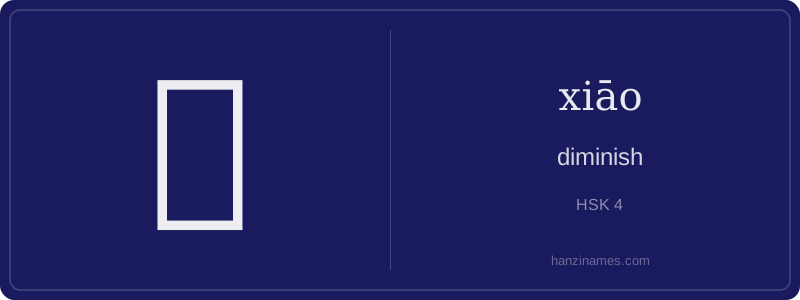
In daily life, 消 is indispensable: it appears in over 200 common compounds, from 消防 (xiāofáng, fire control) to 消费 (xiāofèi, consumption). It’s central to HSK 4 vocabulary and frequently tested for nuance — e.g., 消息 (xiāoxi, news) literally means ‘disappearing trace’, reflecting how information arrives as a faint, transient signal. The idiom 烟消云散 (yān xiāo yún sàn, ‘smoke vanishes, clouds scatter’) has been used since the Tang dynasty to describe complete dissipation — recorded in poetry by Bai Juyi and official histories alike.
Historically, 消 evolved from bronze inscriptions where its precursor combined 水 (water) and 少 (shǎo, ‘few’), emphasizing reduction via flow. By the Han dynasty, the modern form stabilized with 氵 + 肖. There’s no oracle-bone evidence for 消; its earliest confirmed attestation is in early Western Han bamboo slips (c. 2nd c. BCE), consistently meaning ‘to subside’ or ‘to use up’.
As a linguistic detective, I begin at the scene: the character 消 (xiāo) first appears in standardized seal script during the Qin dynasty (3rd c. BCE), already bearing its core semantic structure — the water radical 氵 on the left, signaling association with flow, change, or dissolution, and the phonetic component 肖 (xiāo) on the right, which both hints at pronunciation and historically conveys 'resemblance' or 'likeness' — subtly reinforcing the idea of something losing its original form until it ‘resembles nothing’ of its former self.
Zooming in on the water radical: it’s not merely decorative. In classical Chinese semantics, 氵 often marks verbs involving transformation through movement or dispersion — think of mist dissipating, ink bleeding in water, or tension ebbing like a tide. 消 inherits this logic: diminishment isn’t static erasure but a dynamic, fluid process — whether time wears down sorrow, medicine reduces fever, or bureaucracy absorbs energy.
The phonetic 肖 is key to decoding deeper layers. Though now pronounced xiāo in both 消 and 肖, historical phonology shows 肖 once carried connotations of ‘fading resemblance’ — as in 肖像 (portrait), where likeness is captured *before* decay sets in. Thus, 消 embeds a quiet paradox: to diminish is to let go of fixed identity, entering a liminal state between presence and absence — a concept resonant in Daoist thought and echoed in modern usage like 消失 (disappear) or 消化 (digest, literally ‘break down into assimilable form’).
Example Sentences
Common Compounds
Similar Characters — Don't Mix These Up
Your First Step into Chinese Culture: Get a Chinese Name
Every journey into Chinese begins with a name. Use our free Chinese name generator to create a meaningful, personalized Chinese name that fits you perfectly.
Get My Chinese Name →