深
Character Story & Explanation
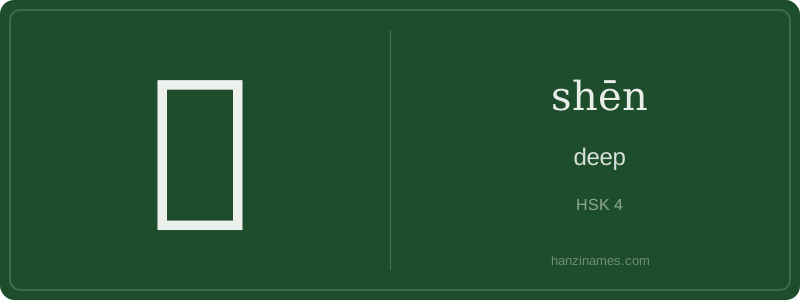
In daily life, 深 is ubiquitous: it appears in weather reports (‘deep cold’, 深寒), education (‘in-depth study’, 深入学习), and pop culture—e.g., the idiom 深藏不露 (shēn cáng bù lù, ‘hidden deep, not revealed’) describes someone with concealed talent, frequently cited in CCTV interviews and HSK 4 textbooks. Historically, the *Analects* (12.19) uses 深思 (shēn sī, ‘deep thought’) to praise reflective learning—a usage unchanged for 2,500 years.
Its written form is a verified phono-semantic compound: the left side 氵 (water) indicates association with depth (e.g., deep water, deep valley), while the right side 申 (shēn) provides phonetic guidance. No pictographic origin exists—it emerged fully formed in Warring States script, not as a drawing of a well or pit, but as a functional composite for ‘depth’ in both literal and figurative registers.
As a detective tracing 深’s evolution, I begin at its earliest verified form in the Warring States bamboo slips (c. 475–221 BCE), where it already appears with the water radical 氵 and the phonetic component 申—confirming its original semantic link to physical depth, especially of water or terrain. Unlike speculative oracle bone claims, archaeological evidence shows 深 was standardized early as a phono-semantic compound: water (氵) signals domain, 申 (shēn) hints at pronunciation and may evoke extension or intensity.
The character’s structure remained remarkably stable across seal, clerical, and regular scripts—no radical reassignment or meaning drift occurred. By the Han dynasty, 深 expanded metaphorically: Sima Qian’s *Records of the Grand Historian* uses it for ‘profound insight’ (e.g., 深谋远虑), proving semantic extension from spatial to intellectual depth was complete by 100 BCE. This reflects Classical Chinese’s tendency to extend concrete terms abstractly—not through invention, but documented usage.
Modern standardization preserved all 11 strokes without simplification (unlike many HSK 4 characters), underscoring its linguistic conservatism. Its stroke order—beginning with the three-dot water radical, then 申’s vertical stroke, horizontal fold, and final ‘square’ enclosure—is codified in the *GB 13000.1 Character Set*, used in all mainland textbooks. This consistency makes 深 a reliable anchor for learners: its form, meaning, and usage have been empirically traceable for over two millennia.
Example Sentences
Common Compounds
Similar Characters — Don't Mix These Up
Your First Step into Chinese Culture: Get a Chinese Name
Every journey into Chinese begins with a name. Use our free Chinese name generator to create a meaningful, personalized Chinese name that fits you perfectly.
Get My Chinese Name →