烤
Character Story & Explanation
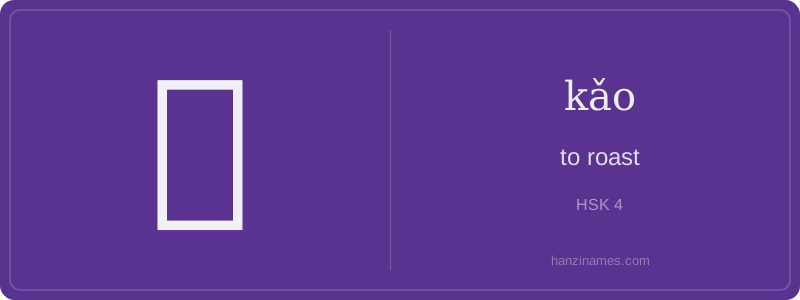
烤 is ubiquitous in modern Chinese life: from street-side 烤冷面 (kǎo lěng miàn, grilled cold noodles) to chain restaurants like Haidilao’s tabletop grills, and home use of electric ovens labeled ‘烤箱’ (kǎo xiāng). It appears in the HSK 4 vocabulary list and is essential for describing common cooking methods. A well-documented phrase is 烤鸭 (kǎo yā, Peking duck), documented as early as the Yuan Dynasty (1271–1368) in imperial records and later codified in Ming-era culinary texts like Food Spectra (《饮膳正要》).
The character is a phono-semantic compound: left radical 火 (fire) indicates meaning; right component 考 (kǎo, ‘to examine; test’) provides sound. First attested in bronze inscriptions of the Warring States period (5th–3rd c. BCE), it originally meant ‘to dry by fire’—a practical technique for preserving meat and grain, later broadening to include roasting and baking.
The character 烤 (kǎo) embodies China’s deep-rooted reverence for fire—not as destruction, but as a transformative, life-sustaining force. In traditional Chinese cosmology, fire (火) is one of the Five Phases (Wǔ Xíng), associated with warmth, vitality, and ritual purification. Roasting food over flame is thus more than cooking: it’s an act of harmonizing human effort with elemental energy, turning raw nature into nourishment through controlled heat.
This worldview manifests in everyday language: 烤 isn’t just ‘to heat’—it implies intentionality and craftsmanship. Whether roasting duck in Beijing, baking buns in Xi’an, or grilling skewers at a summer night market, 烤 signals care, timing, and mastery of temperature—values echoed in Confucian ideals of disciplined practice and Daoist alignment with natural rhythms.
Moreover, 烤 carries subtle social resonance. Shared roasted foods—like 烤串 (kǎo chuàn, grilled skewers)—are central to informal bonding, reflecting the Chinese emphasis on relational warmth (rè qì, 热气) literally and metaphorically. The rising steam, the sizzle, the communal grill—all evoke *qi* (vital energy) made visible, reminding us that in Chinese thought, even cooking is a microcosm of balance, transformation, and human connection.
Example Sentences
Common Compounds
Similar Characters — Don't Mix These Up
Your First Step into Chinese Culture: Get a Chinese Name
Every journey into Chinese begins with a name. Use our free Chinese name generator to create a meaningful, personalized Chinese name that fits you perfectly.
Get My Chinese Name →