烟
Character Story & Explanation
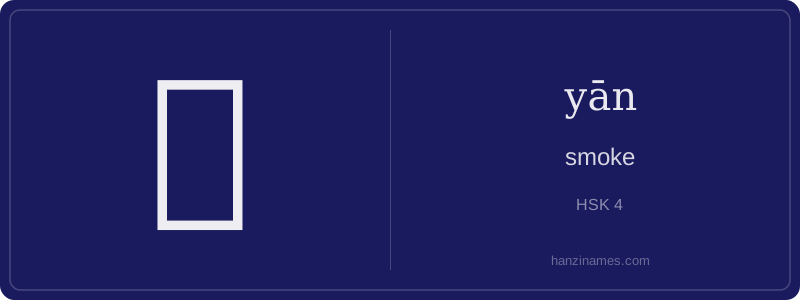
In contemporary China, 烟 most commonly appears in everyday contexts like convenience stores (‘买包烟’ — 'buy a pack of cigarettes'), public signage (‘禁止吸烟’ — 'No smoking'), and health campaigns. It's central to idioms like 人头攒动,烟雾缭绕 (crowded and hazy with smoke), describing bustling teahouses or old-school mahjong parlors. Historically, 烟 entered written Chinese during the Han dynasty, first appearing in texts like the *Shuowen Jiezi* (100 CE) as a variant of 焱, denoting rising vapor from burning incense or herbs.
The character is not a pictograph but a phono-semantic compound: 火 (fire) as semantic radical signals heat/combustion; 因 (yīn) as phonetic component suggests pronunciation. Its earliest standardized form appears in clerical script (Lìshū) inscriptions from the Eastern Han, reflecting its association with ritual fumigation and military signal fires—not tobacco, which arrived via Portuguese traders in the 16th century.
Picture a humid summer afternoon in Chengdu’s Jinli Ancient Street: the air hangs thick with the scent of Sichuan peppercorns, roasted chestnuts, and the faint, acrid curl of cigarette smoke drifting from a red-plastic stool where an elderly man sits puffing slowly on a locally made 'Hongtashan' cigarette. His ash trembles—then falls—onto the worn stone. This is 烟 (yān) in motion: not just smoke as vapor, but as cultural texture—ritual, habit, social lubricant, and quiet defiance of modern anti-smoking campaigns.
The character 烟 carries layered weight in China. While its literal core is 'smoke', it functions as a semantic anchor for tobacco products—cigarettes, pipe tobacco, even hookah embers. Unlike English, where 'smoke' is verb-first ('to smoke'), Chinese uses 烟 as a noun root: you buy a pack of 烟, not 'cigarettes'; you ask '有烟吗?' ('Got smoke?') before a business lunch. It’s shorthand for both substance and act—a linguistic efficiency rooted in daily pragmatism.
Yet 烟 also breathes metaphorically: in poetry, it evokes misty rivers (e.g., 烟雨 'smoky rain'); in history, it signaled frontier watchtowers (烽烟 'beacon smoke'). Modern usage balances this duality—government health warnings feature 烟 prominently ('吸烟有害健康'), while nostalgic ads for aged baijiu still tout '醇厚烟香' ('rich, smoky aroma'). The radical 火 (fire) reminds us: this character begins with combustion—and ends, often, in contemplation.
Example Sentences
Common Compounds
Similar Characters — Don't Mix These Up
Your First Step into Chinese Culture: Get a Chinese Name
Every journey into Chinese begins with a name. Use our free Chinese name generator to create a meaningful, personalized Chinese name that fits you perfectly.
Get My Chinese Name →