父
Character Story & Explanation
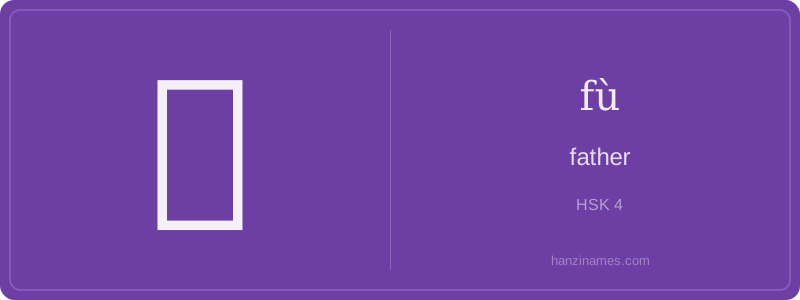
父 is widely used in formal, written, and ceremonial contexts: on tombstones (先父 xiānfù, 'deceased father'), in legal documents (父姓 fùxìng, 'paternal surname'), and in classical idioms like 父母之命 (fùmǔ zhī mìng, 'parents’ command')—a phrase historically tied to arranged marriage norms. It remains essential in genealogical records and official forms requiring paternal lineage.
Archaeologically, 父 appears in early bronze inscriptions (c. 11th–3rd century BCE) as a pictograph resembling a hand holding a ceremonial axe (斧 fǔ), symbolizing paternal authority and ritual leadership. Though simplified over time, its core visual structure—a dot above two downward strokes—retains that ancient association with patriarchal responsibility and protective power.
The Chinese character 父 (fù) is a foundational kinship term meaning 'father'. Unlike English, where 'father' is primarily a biological or legal designation, 父 carries layered cultural weight—evoking respect, authority, and intergenerational duty rooted in Confucian ethics. It appears in formal contexts (e.g., official documents, ancestral tablets) and rarely in casual speech among children, who typically use the more affectionate 爸爸 (bàba) at home.
In traditional Chinese society, 父 was central to the 'Five Relationships' (wǔ lún), where the father-son bond symbolized hierarchical harmony and moral instruction. This contrasts with Western nuclear-family models, where paternal roles emphasize emotional closeness and egalitarian parenting. Even today, using 父 instead of 爸爸 signals formality, solemnity, or literary register—not coldness, but reverence.
While English speakers may equate 'father' with biological parenthood, 父 can extend metaphorically: teachers, mentors, or founders are sometimes respectfully called 师父 (shīfu) or 开山祖师 (kāishān zǔshī), echoing the paternal role as guide and originator. This semantic breadth reflects how Chinese kinship terms encode social function, not just biology—making 父 less a label and more a relational anchor in language and ethics.
Example Sentences
Common Compounds
Similar Characters — Don't Mix These Up
Your First Step into Chinese Culture: Get a Chinese Name
Every journey into Chinese begins with a name. Use our free Chinese name generator to create a meaningful, personalized Chinese name that fits you perfectly.
Get My Chinese Name →