猜
Character Story & Explanation
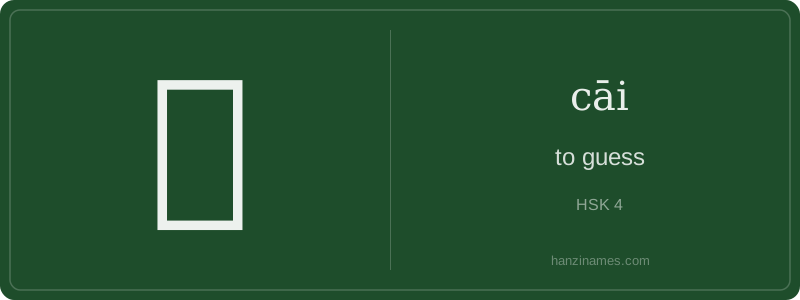
In modern Mandarin, 猜 is ubiquitous in daily interaction: children play ‘guess the number’, students ‘guess vocabulary from context’, and viewers ‘guess the plot twist’ in dramas. It appears in the HSK-4 idiom 猜三道四 (cāi sān dào sì), meaning ‘to gossip baselessly’, revealing its cultural association with unfounded yet socially charged speculation. Historically, it was documented in the 12th-century *Jade Mirror of the Four Unknowns*, where mathematicians used 猜 to describe hypothesis-driven problem solving.
The character’s form is not pictographic but phono-semantic: 犭 (dog radical) signals action-related meaning, while 青 provides phonetic guidance. No oracle bone or bronze script forms survive for 猜—it first appears reliably in clerical script (Lìshū) during the Han dynasty, confirming its relatively late lexical emergence compared to core verbs like 说 (shuō, ‘to speak’).
Unearthing 猜 (cāi) feels like brushing dust from a Han dynasty bamboo slip—its form whispers of ancient uncertainty. The left radical 犭 (quǎn), the ‘dog’ classifier, hints not at canines but at swift, instinctive action: dogs sniff and react before full understanding. This isn’t passive speculation—it’s active, embodied deduction, rooted in early Chinese conceptions of perception as physical engagement with the world.
The right component 青 (qīng), meaning ‘blue-green’ or ‘youthful’, once carried phonetic weight—Old Chinese reconstructions show *tsʰeŋ, closely matching cāi’s modern pronunciation. Though its semantic link to ‘guessing’ is lost, this phonetic pairing stabilized during the Warring States period, appearing consistently in excavated texts like the Guodian Chu Slips (c. 300 BCE), where 猜 appears in contexts of divination and strategic conjecture.
Unlike later abstract verbs, 猜 retained visceral energy: it implies risk, intuition, and provisional truth. In Tang poetry and Ming drama, it often described lovers reading subtle cues—eyes flickering, sleeves trembling—where cognition was inseparable from bodily sensation. This character never meant ‘random guess’; it denoted informed, urgent inference—like a general sizing up enemy banners on the horizon.
Example Sentences
Common Compounds
Similar Characters — Don't Mix These Up
Your First Step into Chinese Culture: Get a Chinese Name
Every journey into Chinese begins with a name. Use our free Chinese name generator to create a meaningful, personalized Chinese name that fits you perfectly.
Get My Chinese Name →