甚
Character Story & Explanation
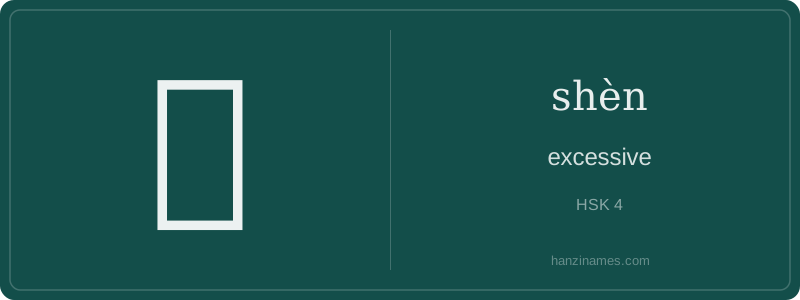
甚 is commonly used in formal speech and writing to express strong degree or warning against excess. It appears in HSK-4+ vocabulary like 甚至 (shènzhì, 'even'), 甚而 (shèn ér, 'furthermore; even to the point of'), and classical idioms such as 何其甚也 (hè qí shèn yě, 'how excessive it is!'). Historically, it appears in pre-Qin texts including the Analects and Mencius, often modifying verbs or adjectives to intensify moral critique.
The character’s form evolved from oracle bone script, where it resembled a person kneeling beneath a roof—possibly indicating 'deep submission' or 'profound state'. By the bronze script era, it standardized into its current structure: top component 甘 (gān, 'sweet/delight') plus two horizontal strokes and a vertical stroke below—though scholars debate whether this reflects phonetic borrowing or semantic abstraction. Today, Chinese learners encounter 甚 most often in compound words rather than standalone use.
甚 (shèn) is a classical Chinese character that conveys intensity, excess, or undue degree—often with a negative or cautionary nuance. Unlike English adverbs like 'very' or 'extremely', 甚 carries an implicit judgment: it suggests something has crossed a reasonable boundary. It appears frequently in formal writing, literary texts, and set phrases, where it adds rhetorical weight and moral or logical gravity.
In modern Mandarin, 甚 functions primarily as an adverb meaning 'excessively' or 'unduly', but it rarely stands alone. Instead, it appears in fixed expressions like 甚至 (even), 甚或 (or even), or 何其甚也 (how excessive!). Its usage reflects Confucian-influenced values emphasizing moderation (中庸 zhōngyōng), making 'excess' inherently suspect—a cultural stance echoed in Aristotle’s doctrine of the golden mean.
Western equivalents include 'undue' (legal/ethical contexts), 'inordinate' (literary/formal), or 'overly' (colloquial critique). Yet none fully capture 甚’s compactness and its embedded normative framework: it doesn’t just describe degree—it signals deviation from an accepted standard. This aligns with East Asian philosophical traditions where balance—not maximum intensity—is the ideal, contrasting with Western individualistic valorizations of extremity (e.g., 'go big or go home').
Example Sentences
Common Compounds
Similar Characters — Don't Mix These Up
Your First Step into Chinese Culture: Get a Chinese Name
Every journey into Chinese begins with a name. Use our free Chinese name generator to create a meaningful, personalized Chinese name that fits you perfectly.
Get My Chinese Name →