疑
Character Story & Explanation
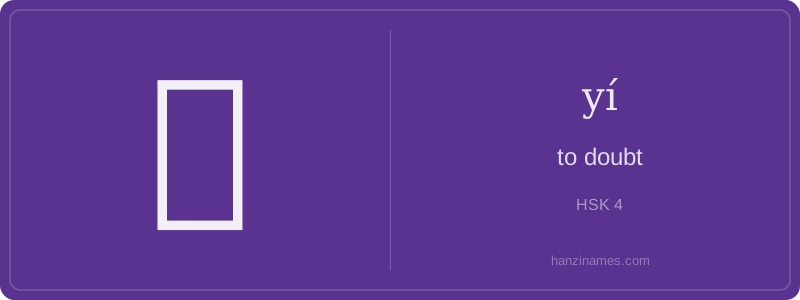
疑 is central to classical Chinese philosophy and modern discourse. Confucius famously said: ‘学而不思则罔,思而不学则殆’ — and thinkers like Zhu Xi later emphasized 疑 as essential to learning: ‘小疑则小进,大疑则大进’ (‘Small doubts lead to small progress; great doubts lead to great progress’). In daily life, it appears in legal documents (e.g., 合理怀疑 ‘reasonable doubt’), news headlines (‘专家质疑该研究方法’), and common idioms like 半信半疑 (‘half-believing, half-doubting’).
The character’s earliest attested form appears in Warring States bamboo texts (c. 475–221 BCE) as a compound of ‘矢’ (arrow) and ‘疋’ (a variant of ‘足’, foot), symbolizing mental hesitation — like an arrow held back, not yet released. Modern scholars (e.g., Li Xiaoding, 《甲骨文字集释》) confirm no oracle bone form survives, but the Warring States script clearly shows its semantic link to suspended action and uncertainty.
Hello students! The character 疑 (yí) means 'to doubt' or 'to suspect' — it’s about feeling uncertain, questioning something, or lacking confidence in truth or reliability. It’s a key verb for expressing intellectual hesitation, not emotional fear. You’ll meet it often in formal speech, academic contexts, and written Chinese. Though it looks complex with 14 strokes, its structure is logical: the top part (匕+矢) hints at uncertainty (like an arrow without a clear target), and the bottom (疋) is the radical, historically linked to foot movement — suggesting mental ‘hesitation’ or ‘pausing before acting’.
This character appears frequently in HSK 4 vocabulary because it reflects mature language use — moving beyond simple facts to critical thinking. Native speakers use it when they’re skeptical but polite: e.g., questioning data, raising concerns in meetings, or expressing cautious curiosity. It’s never aggressive; rather, it conveys thoughtful reserve. Note that 疑 is *not* used for suspicion of crime (that’s more 嫌); instead, it's intellectual doubt — like doubting a theory, a claim, or even one’s own memory.
Don’t confuse 疑 with similar-looking characters like 凝 (to凝, to condense/focus) or 准 (accurate/permit). Its pronunciation yí is shared with other common words (e.g., 移 yí ‘to move’, 宜 yí ‘suitable’), so listen carefully. Practice writing it slowly: start with the top left ‘匕’, then ‘矢’, then the ‘疋’ base. Repetition builds muscle memory — and confidence, which is the perfect antidote to doubt!
Example Sentences
Common Compounds
Similar Characters — Don't Mix These Up
Your First Step into Chinese Culture: Get a Chinese Name
Every journey into Chinese begins with a name. Use our free Chinese name generator to create a meaningful, personalized Chinese name that fits you perfectly.
Get My Chinese Name →