盒
Character Story & Explanation
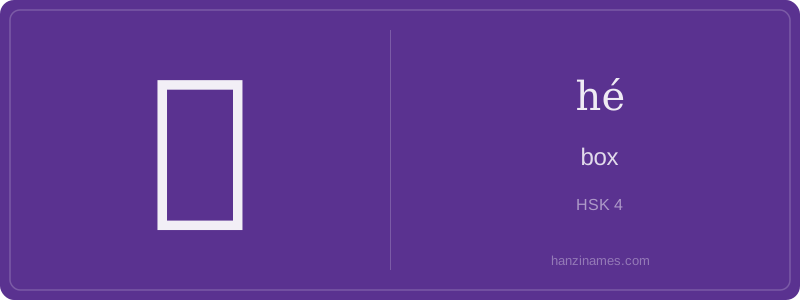
In daily life, 盒 is ubiquitous: takeout food arrives in 食盒 (shíhé, 'food boxes'), cosmetics are sold in 化妆盒 (huàzhuānghé, 'makeup boxes'), and students carry pencil cases called 文具盒 (wénjùhé). Historically, during the Song and Ming dynasties, lacquered 盒 were prized for storing inkstones, seals, and tea leaves—documented in inventories like the 12th-century *Yunlin Shilue*. It appears in the Ming encyclopedia *Sancai Tuhui*, labeled clearly as a small, lidded storage vessel.
The character is not pictographic—it doesn’t visually mimic an ancient box. Instead, it’s a phono-semantic compound: 皿 (radical, meaning ‘dish/vessel’) + 合 (phonetic and semantic element, meaning ‘to close’). No oracle bone form exists; its earliest verified forms are Han-dynasty bamboo slips and clerical inscriptions, where it already bears its modern structure.
Our detective begins at the crime scene: the character 盒 (hé), meaning 'small box'. At first glance, it looks like a container—fitting, since its radical 皿 (mǐn) is the 'vessel' or 'dish' radical, historically used for all kinds of receptacles. The top component 合 (hé) means 'to close', 'to join', or 'to fit together'—a phonetic clue and semantic partner, suggesting a lid sealing shut. This dual-layered structure—form + function—is classic Chinese character logic.
Zooming in on the evidence: 盒 first appears reliably in clerical script (lìshū) during the Han dynasty (206 BCE–220 CE), not earlier oracle bones or bronzes. That tells us it’s a later, functional invention—not ancient ritual ware, but everyday packaging. Its 11 strokes are carefully balanced: 5 for 合 (top), 6 for 皿 (bottom)—no wasted motion. The horizontal stroke across the top of 合 acts like a lid; the open bowl shape of 皿 cradles what’s inside.
Forensic linguistics confirms 合 also serves as the sound source: both 合 and 盒 share the pronunciation hé in Standard Mandarin. No tone shift, no dialect drift—clean phonetic borrowing. And crucially, 盒 never meant 'large chest' or 'cabinet'; historical texts consistently use it for portable, hand-sized containers—tea caddies, medicine cases, cosmetic boxes. Its scale is intimate, its purpose precise: containment with closure.
Example Sentences
Common Compounds
Similar Characters — Don't Mix These Up
Your First Step into Chinese Culture: Get a Chinese Name
Every journey into Chinese begins with a name. Use our free Chinese name generator to create a meaningful, personalized Chinese name that fits you perfectly.
Get My Chinese Name →