矿
Character Story & Explanation
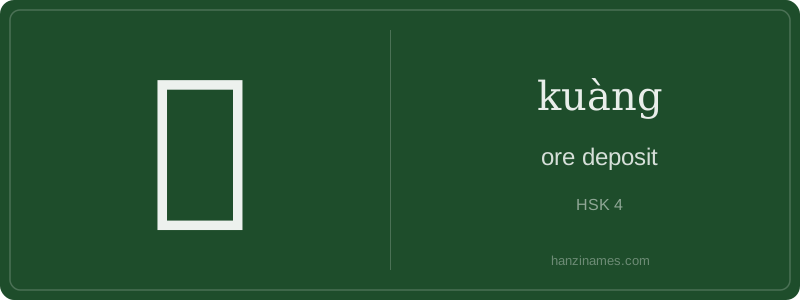
In daily life, 矿 appears ubiquitously in China’s resource economy: mining licenses (采矿证, cǎikùn zhèng), environmental impact reports, and news headlines about rare-earth extraction in Jiangxi or iron ore imports from Australia. It’s central to the ‘dual carbon’ goals—e.g., ‘green mining’ (绿色矿山, lǜsè kuàngshān) is a national standard launched in 2018. Common phrases include 矿产资源 (kuàngchǎn zīyuán, 'mineral resources')—a term enshrined in China’s 1996 Mineral Resources Law.
The character is not pictographic. Its earliest verified form appears in Song-dynasty (960–1279) rhyme books and Tang steles as a phono-semantic compound. There’s no oracle bone or bronze script precursor. Instead, picture a geologist in Inner Mongolia today marking ‘铜矿’ (tóng kuàng, copper ore) on a digital survey map—this is where 矿 lives: precise, technical, and institutionally grounded.
Our detective work begins at the crime scene: the character 矿. At first glance, it’s a simple 8-stroke glyph—but look closer. The left radical 石 (shí, 'stone') is our anchor: a clear semantic clue pointing to geology, rock, and earth. This isn’t coincidence—it’s design. In Chinese character logic, radicals don’t just decorate; they categorize. So before we even read the right side, we know this character belongs to the mineral world.
The right component 广 (guǎng) is our prime suspect—and not for its meaning ('broad', 'extensive'), but for its phonetic role. In ancient Middle Chinese, 广 contributed a *kwaŋ*-like sound, closely matching kuàng. This is classic xíngshēng (phonosemantic compounding): stone + sound = 'ore deposit'. No mystical oracle bones here—just centuries of linguistic engineering refined in dictionaries like the Kangxi (1716), where 矿 appears under the Stone radical with precisely this function.
Crucially, 矿 wasn’t always written this way. Pre-Qin texts used variants like 礦 (with a more complex right side), but simplification in 1956 standardized 矿 as the mainland form. Its evolution reflects policy as much as linguistics: a streamlined character for a modernizing industrial nation. Even today, when geologists log field notes or mining permits are issued by China’s Ministry of Natural Resources, this compact 8-stroke glyph carries legal, economic, and geological weight—no embellishment needed.
Example Sentences
Common Compounds
Similar Characters — Don't Mix These Up
Your First Step into Chinese Culture: Get a Chinese Name
Every journey into Chinese begins with a name. Use our free Chinese name generator to create a meaningful, personalized Chinese name that fits you perfectly.
Get My Chinese Name →