禁
Character Story & Explanation
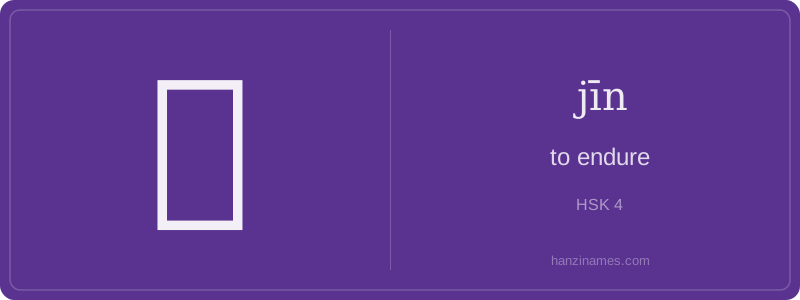
In modern Chinese, 禁 is most frequently encountered in compound words denoting prohibition (jìn) — e.g., 禁止 (jìnzhǐ, 'forbidden'), traffic signs (禁止吸烟), and legal codes. Its endurance sense (jīn) survives in formal or literary contexts: 忍无可忍,无需再忍 — but crucially, 禁受 (jīnshòu) and 禁得起 (jīn de qǐ) remain standard HSK-4 vocabulary meaning 'to withstand' or 'to bear'. It appears in the idiom 禁不起风吹草动 (‘cannot withstand even a breeze’), used in economic reporting since the 1990s to describe fragile markets.
The character’s form has no pictographic origin — it’s a phono-semantic compound. The left 示 radical signals religious or ceremonial gravity; the right 今 was adopted for sound, not meaning. No oracle bone inscriptions of 禁 survive; earliest verified forms appear in Warring States bamboo manuscripts (c. 475–221 BCE), where it consistently conveys authoritative restraint.
As a linguistic detective, I begin at the scene: the character 禁 appears in early seal script (c. 3rd century BCE) with a clear structure — the ‘altar’ radical 示 (shì) on the left, signaling ritual or divine authority, and 林 (lín, 'forest') on the right — not as nature imagery, but as a phonetic component borrowed for its sound, later evolving into 今 (jīn). This layout reflects ancient state control: prohibitions were sacred decrees, inscribed on bronze vessels and bamboo slips to enforce moral and legal boundaries.
The dual pronunciation jīn (endure, bear) and jìn (forbid, prohibit) isn’t random — it’s a classic case of *tonal derivation* in Middle Chinese. The rising tone (jǐn → jìn) marked the causative or intensified sense: ‘to cause to endure’ → ‘to suppress’, while the level tone (jīn) preserved the original verb meaning. This semantic split is documented in the *Shuōwén Jiězì* (121 CE), China’s first dictionary, which defines 禁 as ‘to restrain; to endure with effort’.
Visually, the 13 strokes encode layered authority: the 示 radical grounds it in ritual obligation; the top of 今 resembles a lid or seal, suggesting containment; and the lower strokes evoke tension — like holding breath or suppressing impulse. In classical texts like the *Analects*, 禁 appears in phrases like ‘禁于未发’ (‘restrain before eruption’), revealing Confucian emphasis on self-discipline over external punishment — endurance as ethical foundation, not passive suffering.
Example Sentences
Common Compounds
Similar Characters — Don't Mix These Up
Your First Step into Chinese Culture: Get a Chinese Name
Every journey into Chinese begins with a name. Use our free Chinese name generator to create a meaningful, personalized Chinese name that fits you perfectly.
Get My Chinese Name →