尽管
How to Understand
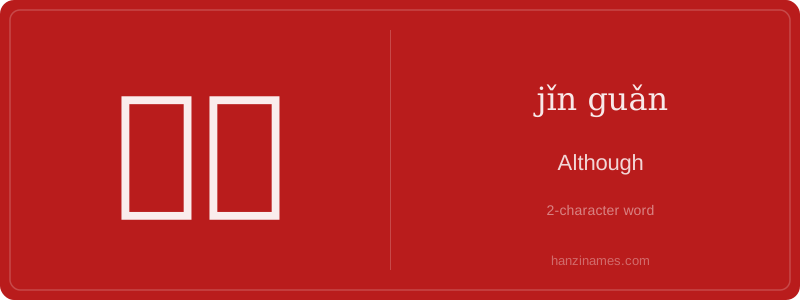
尽管 is a conjunction that means 'although' or 'even though,' used to introduce a clause that contrasts with the main clause. It expresses a condition or situation that does not prevent the main action or outcome.
The character 尽 (jǐn) originally meant 'to exhaust' or 'to reach the limit,' while 管 (guǎn) was a noun meaning 'a tube' or 'a handle.' Over time, 管 came to be used as a verb meaning 'to manage' or 'to control.' Together, 尽管 evolved into a conjunction expressing contrast, similar to 'although' in English.
尽管 is commonly used in both formal and informal contexts to show contrast. For example, it can be used in sentences like “尽管下雨,我们还是去了公园” (Although it rained, we still went to the park). It is an essential word for expressing exceptions or opposing ideas in Chinese.