尽
Character Story & Explanation
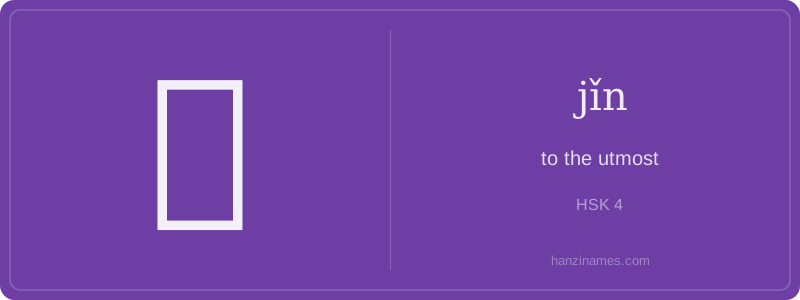
尽 is ubiquitous in modern Mandarin, especially in set phrases like 尽量 (jǐnliàng, 'as much as possible') and 尽快 (jǐnkuài, 'as soon as possible'), both HSK 4 vocabulary items. It appears in formal documents, medical instructions ('take medication as prescribed, 尽量按时'), and public notices ('请尽快办理'). The idiom 物尽其用 (wù jìn qí yòng, 'make full use of everything') reflects China’s longstanding emphasis on resource efficiency, echoed in state policy slogans since the 1950s.
The character’s earliest attested form appears in bronze inscriptions of the Western Zhou (c. 1046–771 BCE), where 尽 (then written with a different phonetic component) already conveyed 'exhaustion' or 'completion'. Its current shape—radical 尸 ('body') + (a simplified phonetic element derived from 尹)—was standardized in the Qin dynasty’s Small Seal script. No oracle bone form survives; its documented evolution centers on administrative and ritual texts, not mythic origins.
The Chinese character 尽 (jǐn/jìn) embodies a profound cultural ideal: exhausting all possibilities, resources, or effort to achieve completeness or sincerity. Unlike English adverbs like 'fully' or 'completely', which are often neutral descriptors, 尽 carries moral weight—suggesting duty, earnestness, and relational responsibility. In Confucian-influenced contexts, it reflects the virtue of giving one’s utmost in filial piety, governance, or friendship.
Its dual pronunciation signals distinct grammatical roles: jǐn (adverbial, 'as... as possible') and jìn (verb, 'to exhaust/use up'). This functional split mirrors how Chinese prioritizes context over inflection—meaning emerges not from endings but from position and tone. Western equivalents like 'utmost' or 'to the hilt' evoke intensity but lack 尽’s embedded sense of ethical obligation and relational reciprocity.
Compared to Western individualistic ideals of 'maximizing potential', 尽 emphasizes relational fulfillment—e.g.,尽孝 (jìnxìào, 'exhaust filial duty') isn’t about personal achievement but honoring interdependence. Its radical 尸 (shī, 'corpse') historically denoted 'body at rest', evolving to imply 'completion of role'—a subtle reminder that 'giving all' is inseparable from social positioning and ritual integrity in traditional Chinese thought.
Example Sentences
Common Compounds
Similar Characters — Don't Mix These Up
Your First Step into Chinese Culture: Get a Chinese Name
Every journey into Chinese begins with a name. Use our free Chinese name generator to create a meaningful, personalized Chinese name that fits you perfectly.
Get My Chinese Name →