仅
Character Story & Explanation
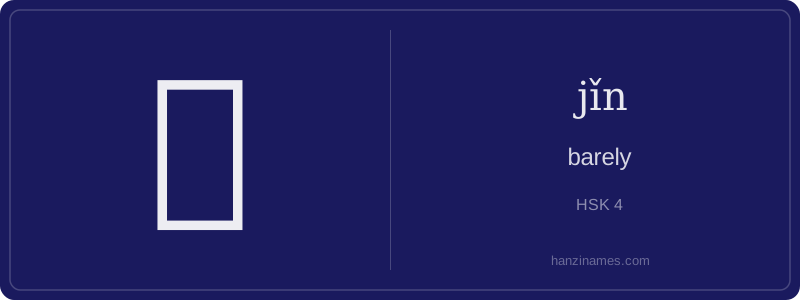
In contemporary Mandarin, 仅 is indispensable in formal writing, news reports, and technical documentation—signaling narrow margins: '仅存三例' (only three cases remain) in medical journals, or '仅支持USB-C' (supports USB-C only) in product specs. It appears in the fixed phrase 仅仅 (jǐn jǐn), meaning 'merely' or 'nothing more than,' widely used in spoken and written Chinese. Historically, it appears in Ming-era legal codes specifying evidentiary thresholds: '证仅一人' (testimony from only one person), underscoring its role in defining sufficiency.
The character is not pictographic; it’s a phono-semantic compound. The left radical 亻 denotes human-related meaning, while the right component 又 (yòu) serves phonetically—though its original pronunciation diverged over time. Its earliest attested form appears in seal script (c. 3rd century BCE), already standardized as a functional quantifier—not an oracle-bone ideogram.
As an archaeologist brushing dust from a Han dynasty bamboo slip, I uncovered 仅 not as a relic of myth, but of precision—carved in clerical script to mark scarcity in tax records: 'only three bushels collected' or 'merely one witness present.' Its minimal four strokes conceal a rigorous semantic economy, born when scribes needed to express insufficiency without ambiguity. This wasn’t poetic license—it was administrative necessity, etched into legal and census documents where 'barely' carried legal weight.
The radical 亻 (person) anchors 仅 in human experience—not abstract limitation, but *humanly constrained* capacity: barely enough time, barely sufficient evidence, barely surviving hardship. Unlike abstract quantifiers, 仅 always implies a threshold crossed—or nearly missed. Its phonetic component 又 (yòu, 'again') is no coincidence: it signals repetition of near-failure—'again just short,' echoing in bureaucratic reports across centuries.
In Tang steles and Song printed texts, 仅 evolved from strict fiscal terminology into literary restraint—used by poets like Du Fu to underscore fragility: 'only this single boat remains' amid war’s ruin. Modern linguists confirm its syntactic rigidity: it must precede verbs or adjectives, never stand alone. This grammatical fossilization reveals how deeply its 'barely' meaning was codified—not as mood, but as grammatical marker of marginal adequacy, preserved across dynasties like carbonized grain in a tomb.
Example Sentences
Common Compounds
Similar Characters — Don't Mix These Up
Your First Step into Chinese Culture: Get a Chinese Name
Every journey into Chinese begins with a name. Use our free Chinese name generator to create a meaningful, personalized Chinese name that fits you perfectly.
Get My Chinese Name →