伤
Character Story & Explanation
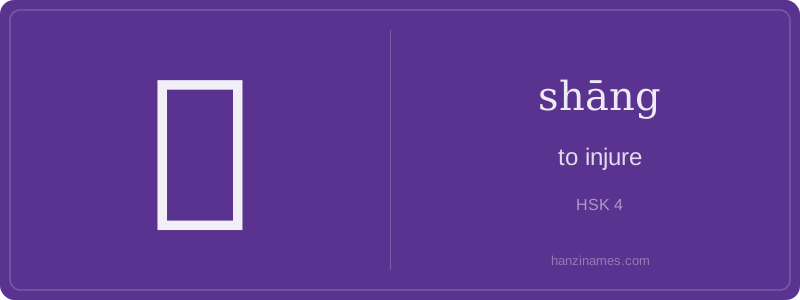
In daily life, 伤 appears ubiquitously: hospital signs read 外伤科 (wàishāngkē, ‘trauma department’), news reports cite 人员受伤 (rényuán shòu shāng, ‘people injured’), and idioms like 两败俱伤 (liǎng bài jù shāng, ‘both sides suffer losses’) warn against zero-sum conflict—a principle deeply embedded in diplomatic and business discourse since at least the Warring States period (475–221 BCE). The phrase is documented in the Han-dynasty text Shuoyuan.
The character evolved from seal script (c. 3rd century BCE), where its right side resembled a wounded person (with a bent limb) under a knife-like stroke—later stylized into 丬. Modern 伤 is not pictographic but phono-semantic: 亻 (person) + 丬 (phonetic component, historically related to shāng sound). No oracle bone form survives, so scholars rely on bronze inscriptions and early dictionaries like Shuowen Jiezi (100 CE), which defines it as ‘to harm, to impair’.
The character 伤 (shāng) embodies a profound Chinese understanding of harm—not merely physical, but relational, emotional, and moral. In classical thought, injury extends beyond the body to include damage to harmony (和), reputation (名), or virtue (德). This reflects Confucian and Daoist sensibilities: a wound to another’s dignity or to social trust is as consequential as a cut on the skin. Thus, 伤 carries ethical weight—every act of causing harm implicates one’s moral cultivation.
Etymologically linked to the radical 亻 (person), 伤 foregrounds human agency and consequence. Its right component, 丬 (a variant of 羊, ‘sheep’ in ancient forms), historically suggested sacrifice or vulnerability—echoing how injury often arises from exposure, loss, or yielding. In traditional medicine (e.g., Huangdi Neijing), ‘injury’ includes wind-cold invasion or emotional excess (like excessive grief injuring the lungs), revealing a holistic view where psyche, environment, and physiology intertwine.
This worldview rejects sharp binaries between ‘physical’ and ‘emotional’ harm. To say 他伤了心 (tā shāng le xīn, ‘his heart was injured’) is not metaphorical—it describes a real physiological and spiritual condition recognized in both classical texts and modern clinical psychology in China. Healing, therefore, demands restoration of balance (调和), not just repair—mirroring acupuncture, herbal therapy, and counseling alike. Injury is never isolated; it ripples through self, family, and cosmos.
Example Sentences
Common Compounds
Similar Characters — Don't Mix These Up
Your First Step into Chinese Culture: Get a Chinese Name
Every journey into Chinese begins with a name. Use our free Chinese name generator to create a meaningful, personalized Chinese name that fits you perfectly.
Get My Chinese Name →